Showing posts with label starlings. Show all posts

Sunday, November 6, 2011

Accepting the Birds that Come

It is currently 39 degrees and sunny in Seattle, but I'm sitting here at my desk in a heavy coat because my dogs want to have access to the front deck.  Sigh.

Long ago, when I was an art student, studying drawing and photography, I learned a valuable lesson:  don't wait for the perfect subject, draw what's in front of you.  It seems like an easy principle to master, but it turns out it's one of those things you have to learn over and over again.

Starling and Sparrow, familiar visitors, in an uncommon mutual pose.
Take birds, for example.  As a birdwatcher, and as a photographer, I am always hoping for the next big, unexpected find.  For some rare (or at least previously unseen) bird to fly onto my yard list, or alight on the bushes at the dog park.  Of course, the definition of "rare" means that it's something which very seldom happens.  So the artist who waits for "rare" subjects -- unless he takes off for Tahiti like Gauguin -- may have a long wait.  (I couldn't come up with Paul Gauguin's name to save my life just now, so I Googled "Tahiti Artist" and it was the first hit -- I love the Internet.)  There are days when I take my camera outside and I think, "Nothing here but more chickadees, Juncos and pigeons.  I have thousands of pictures of them, why do I need more?"

Beautiful rich colors make this Junco stand out.
The answer is, "I don't."   But I need to take more pictures of them.  It's not the end product, it's the process.  That may sound like a cliche, but it's true.  Most basically, because it keeps your skills and your eye sharp -- the way practicing scales keeps a musicians hands limber and ears tuned.  But it's also true for a couple of other reasons (that I know how to articulate).

First, is receptivity.  As an artist -- photographer, writer or birdwatcher -- receptivity is one of the most important traits you can possess.  (Reactivity is another, but I'll write about that some other day.)  You could compare it to the chemical nature of film (remember film?  If you're too young, Google it).  The chemicals on the film are sensitive to light and they react in its presence, creating an image.  Similarly, the artist has to be available to the "light" of the world around him, has to let it in and let it change him.  The inner film develops these images, stores them, and they become the raw material out of with art is created.  Standing on my deck, with my camera, I am at my best when I can cultivate a state of open receptivity.  If I was religious I could phrase it as, "Not my will, but yours be done."  In other words, I will accept what comes. I'll photograph what's in front of me instead of complaining that I don't get anything "new".  Out of that openness comes possibility, the chance for something unexpected and creative to occur.  Without that openness, nothing is possible.
A distinctive mostly white Pigeon surveys the deck.

I love pigeons!
Henry James -- not usually one of my favorite writing mentors, but you really can't escape his influence -- advised us to strive to be someone on whom nothing is lost.  The emphasis on striving (James said, "try" but it's the same point) is important.  It's a goal we can't reach.  Still, it's crucial.  As soon as I begin thinking, "Oh, they're just chickadees, just pigeons, I've seen them a thousand times before," then the doors of my perception are closed.  The world is being lost on me.  The chickadees that I see today may or may not be the actual birds I've seen before -- it's very difficult to tell.  (Actually, sonograms of the songs of individual birds can help you identify whether the particular birds in your yard are the ones you've seen before -- another topic to get into later.)  With pigeons it's a little easier.  I saw four pigeons on my deck yesterday and, because I forced myself for a moment to put down all the things I was worrying about and everything I "should" be doing, I got some really great photos of them.  Two of them I knew and two were really striking, mostly white birds that I'm not sure I've seen before.  I love pigeons, but familiarity can blunt even our greatest passions.  Only openness and receptivity -- being the present moment without any certainties -- can reignite that love.  My pigeons reminded me of that.
Like the Four Stooges having lunch.

And ultimately, the birds that I see today are not the birds that I've seen before -- and I am not the person who saw them.  A photographer knows that from moment to moment the light moves and the image changes.  The photographer changes too.  No amount of clinging to my opinions or preferences will prevent that.  Tomorrow, the birds will be different and I will be different.  The tree will have a few less leaves, the monster dog on the deck beside me will be a little bigger, and the light will keep moving.


And the pigeons will have something new to say.


 ###

 I've been a little busy this month doing NaNoWriMo and other writing related activities.  So far, it's been a pretty good year for writing.  If you're interested, you can check out some of my other work.  Starting with our sister Blog, Books and Beasts.  Also, the Seattle Mariners Blog, Sodo Mojo has been hosting my posts every Sunday morning for a couple of months.  You can check out some of my pieces (and the great baseball analysis of the rest of the site's writers) here


Many of the original photographs featured on Birdland West are available for sale as art quality prints.  You can check out all of our offerings at http://AlexWashoe.imagekind.com.  If you see an image here that does not show up on our Imagekind site please contact me directly and I'll let you know about availability.)


Tuesday, September 20, 2011

A Busy Day at the Bird Feeders


Yesterday, in the afternoon, the sun came out unexpectedly after a cold, rainy weekend.  The yard was glistening in a way that I usually associate more with spring than late-summer-fading-into-Autumn.  But then, we didn't get much spring in Seattle this year, so I'll take it.

Black-Capped Chickadee with his prize, perched in cherry tree.
Waiting his turn.
I don't know if it was the sunshine, the cooler, crisper temperatures or just a coincidence, but suddenly the yard was alive with birds.  Chickadees, who are always around, were out in force.  They queue up in the cherry tree and wait their turn at the feeder -- it seems to be a chickadee rule that only one bird can use the feeder at time.  Sparrows and finches and Juncos are glad to double up, but chickadees wait their turn.  Usually, the next chickadee waits on the branch above the feeder until the one who is there leaves.  They never take very long, picking out the seed they want and flying back up into the tree with it.  Every once in a while a chickadee approaches the feeder and realizes at the last minute that there's someone already there, then pulls up in a whuff of wings and lands in the tree.  But they never seem to squabble the way sparrows and other birds do.  It's all very orderly and efficient.


I wasn't the only one watching the chickadees yesterday.  Another familiar visitor was out and about.  I'm pretty sure that this is the same young House Finch that I photographed (and blogged about) earlier this summer.   


He's looking much more adult now, but he still has a tentative, uncertain air.  I didn't ever see him use the feeder, but he did sit on the chickadees' queue branch and watch them for quite awhile.  It seemed like he was observing their use of the feeder. 


 I also saw another return guest.  This Bewick's Wren was foraging in the Morning Glory vines along the fence.  I haven't seen a BW in months.


 And, the young Anna's Hummingbird that I've seen and reported on a couple of times recently was back.   In fact, I could hear her periodically throughout the day -- a rapid chirp sound like a high-pitched telegraph key -- but it wasn't until late in the afternoon (when the light was fading) that I managed to get some shots of her.


So, counting the crows who were foraging on the sidewalk and the House Sparrow at the feeder -- not counting the Starlings I could hear in the back yard or the pigeons who I didn't see until evening -- that's five species that I counted standing on my deck, without even really trying hard.  None of them were new or unusual, but it was still pretty exciting.


And just to top things off, today I was drawn outside again by the Anna's Hummingbird sound, only to find a totally different bird at the feeder.  This one, as you can see, is quite a bit larger and clearly full grown.


 If you like Birdland West, you might also want to check out our sister blog Books and Beasts, which focuses on reviews of books about animals and related topics.

 Many of the original photographs featured on Birdland West are available for sale as art quality prints.  You can check out all of our offerings at http://AlexWashoe.imagekind.com.  If you see an image here that does not show up on our Imagekind site please contact me directly and I'll let you know about availability.)


Tuesday, June 21, 2011

House Finches, the First Day of Summer, and Baseball


Finally got a decent photo of the male House Finch, seen here with his mate.
Today is the first day of Summer and I awoke this morning to the song of House Finches.  This couple (I assume it's the same couple -- I frequently see them together and never see more than one of each gender at a time) have been around since late winter/early Spring although I've been seeing a lot more of them in the last couple of weeks.  The female has posed for some good pictures but the male continues to be very elusive.  This morning I saw them eating on the rail of my deck -- food that I put out for our resident (and slightly mentally handicapped, I believe) pigeon Timmy.  Juncos, Sparrows, Starlings and the occasional crow also stop by to sample Timmy's food, but this is the first time I've seen the Finches there. 

The guides say that House Finches are only seen individually during nesting season, and that other times they tend to form large flocks.  I haven't seen any flocks, just this couple, who have been around most of the Spring.  But I also haven't seen any fledglings, and I was thinking that it must be late in the season for nesting.  But my naturalist friend, Kevin, assures me that it's still very much nesting season for House Finches.  "Sometimes they get a late start and may not have fledglings until the middle of July," he says, "or they get an early start and raise two broods of young in one season.  Keep your eyes peeled because you still may see some fledglings before the summer is over!"

I will definitely be watching.

Her Majesty, Lulubelle, enjoys the sun and watches for rats on the first day of summer.
I started this blog a little over two months ago (it seems much longer) at the beginning of a spring that has been unusually wet and cool here.  We are still well below our average temperatures in Seattle (today it's going to get up to a lovely 75, but it's not going to last --  tomorrow the drizzle comes back).  These conditions are creating all kinds of problems.  Today on the news I heard that the state's strawberry crop is delayed and may be the latest crop in many years.  Here at home my own garden has grown much slower than anticipated and my plans to outfit my yard for hummingbirds this year might have to wait.  

Also, there have been an unusual number of bear sightings in the suburbs -- it's been going on for a couple of years but this year it seems even worse.  Part of the problem is that the edges of the Greater Puget sound urban sprawl are pushing further and further into the greenbelt areas that the bears depend on.  But part of the problem also is the unusually cool weather which has retarded the food sources at higher altitudes and the hungry spring bears are coming down into the inhabited areas to look for food. That often ends badly for the bear.

I hope to bring you more about the bears in the near future.

Back in my first post I featured rats, starlings and Flickers.  They're all still here.  I haven't seen the Flickers as much lately and they've stopped their incessant banging on the side of the house in the mornings.  But I hear them frequently, especially early in the day. 

The rats are still here, and multiplying.
 The rat is not only still here, but now there are several smaller rats around as well.  Obviously, reproduction has occurred.  The rats seem quite comfortable in the yard, although my dog Lulubelle, true to her terrier ancestry, keeps a close eye on them and lets them know if they get out of line.  (I don't know what the "rules" are for the rats, but Lulubelle does.  She's a very rule oriented girl.)


Starlings in their shimmering summer colors
 And the starlings, of course, are still here too.  They've gone from their brown, brightly spotted winter colors to their resplendent summer iridescent purple and green.  That's because earlier in the year their new feathers are growing in, the white tips of which give them the white spots.  Now the tips have worn away, and their spring and summer colors shimmer.  All About Birds says this unusual way of changing colors is called "wear molt".  


Ichiro is hitting again and the Mariners are in contention.  What a great way to start summer.
Today -- the first day of Summer -- we are just enjoying the sunshine, watching the birds, waiting for the baseball game to start. (The Seattle Mariners-- who took two games out of three this weekend from the Phillies, the best team in baseball right now --  are in DC today, playing the Washington Nationals, and are one game out of first. Who could have predicted that?) (They lost, giving away a four run lead in the ninth inning -- but it was still a good day.)

And, of course, all of us are hoping for more good weather.

 ###


Birdland West readers will be interested in my review of Feathers: The Evolution of a Natural Miracle by Thor Hanson, which is posted now at Books and Beasts.   It's a great book and a must read for all bird lovers.  Check out the review here.


 (Many of the original photographs featured on Birdland West are available for sale as art quality prints.  You can check out all of our offerings at http://AlexWashoe.imagekind.com.  If you see an image here that does not show up on our Imagekind site please contact me directly and I'll let you know about availability.)


Monday, May 30, 2011

Sizing up songbirds: My favorite trick for identifying birds

What's the first thing you notice when you glimpse a strange bird?

Not too long ago, I didn't know a black-capped chickadee from a Dark-eyed Junco.   Of course, I knew a hummingbird when I saw one, and I was familiar with gulls and crows.  But I spent too much time in the heart of the city, and I wasn't very good at being still long enough to really see the smaller songbirds around me.

Now, I probably recognize a dozen or more species of songbirds on sight -- sometimes just by the way they move or fly.  And though I'm not a very good "by ear" birder, I have learned the songs and calls of many of my most familiar species.

Color and movement command attention.  But are they the best keys to identification?
But a couple of unusual visitors in the past week have gotten me to thinking about the perennial bird watcher's question:  what is the best way to identify a bird in the field?  If you look around at bird books and blogs and magazines you will find endless information and advice on this topic -- much of it very good.  But, as a novice myself, I thought it might be helpful to say something about how I have learned to do it in the past year.  

So again, what's the first thing you notice when you catch sight of an unknown bird?

Probably color.  Color demands our attention.  And movement.  Location, in a tree, in a bush, on the ground.  Songs and calls.  All of these are vital clues.  But the problem is that there's so much relevant information, and often our chance to observe the bird is so brief, that it can be hard to know what we should pay attention to first.

I've learned a little trick that works very well for me, and often provides a key to figuring out a bird's identity.  It's not unique to me -- I've done a lot of reading in the past year and had the opportunity to pick the brains of people who know a lot more than I do -- but I've been able to adapt it to my area and habits.  What I've done is train myself to ask a different question first, one that's not nearly as instinctive as some of the others: How big is this bird?

Bushtits are the smallest songbirds in North America.
Among songbirds, size is crucial.  Knowing the approximate size dramatically narrows the possibilities.  Then the other things I notice -- color patterns, movement, location, song -- all become much more useful, because there are a lot less candidates to choose from.

If you're like I was, you're thinking, "How in the world do you expect me to guess the size of a bird that I see for less than a minute a hundred feet away?"  In my mind, when I started out, all small birds were "sparrows" and I was convinced I couldn't tell them apart.  Little did I know there was a whole galaxy of smaller-than-sparrow species to learn.

The trick is, you don't have to know how big a bird is in centimeters or fractions of a gram.  All you have to know is relative size.  How big is the bird compared to species you already know?  If you can place him between two species you know, then the task of identifying him becomes much simpler.

Everyone knows Robins, which makes them the perfect beginning metric for birdwatchers.
In my head, I have gradually built up a scale.  It will be a little different depending on where you live, and what birds you're familiar with.  But you don't have to know a lot of birds to start.  Two or three species is enough to start making valuable guesses about size.  (Even something as simple as "Is it bigger or smaller than a Robin?" can be very valuable.)

Crows are the largest songbirds most city-people see regularly.
For instance, in my neighborhood, the smallest songbirds around are bushtits.  (Actually they're the smallest songbirds in North America, about the size of an Anna's Hummingbird.)  And the largest songbirds are Crows.  (There are occasional Raven sightings out here in West Seattle, but they are very rare.)  Around here, if it's bigger than a crow, it's not a songbird.  You're into groups like hawks and gulls then.


My personal scale runs -- roughly -- like this:  Bushtits, Black-Capped Chickadees, Dark-eyed Juncos, House Sparrows, Robins, Steller's Jays, Crows.   This is a pretty good scale for where I live.  Nine times out of ten, if I get a good look (or a good photo) I can pretty quickly place the bird on my scale.

So when I glimpse that unknown visitor in the cherry tree, I ask myself about his size.  I know he's bigger than a House Sparrow, not quite as big as a Robin.  Once I know that, I can easily leverage whatever other information I have -- orange chest, black head and wings, white bars on the wings -- into a good identification:  That's a Black-Headed Grosbeak.

And what could be more satisfying to a bird watcher than that?


(I'd love to hear some of your favorite aids to identification.  Feel free to leave them in the comments.)

RELATED POSTS


If you like Birdland West, you might also want to check out our sister blog Books and Beasts, which focuses on reviews of books about animals and related topics.


(Many of the original photographs featured on Birdland West are available for sale as art quality prints.  You can check out all of our offerings at http://AlexWashoe.imagekind.com.  If you see an image here that does not show up on our Imagekind site please contact me directly and I'll let you know about availability.)


Monday, April 25, 2011

The Invaders (Part One of Three)


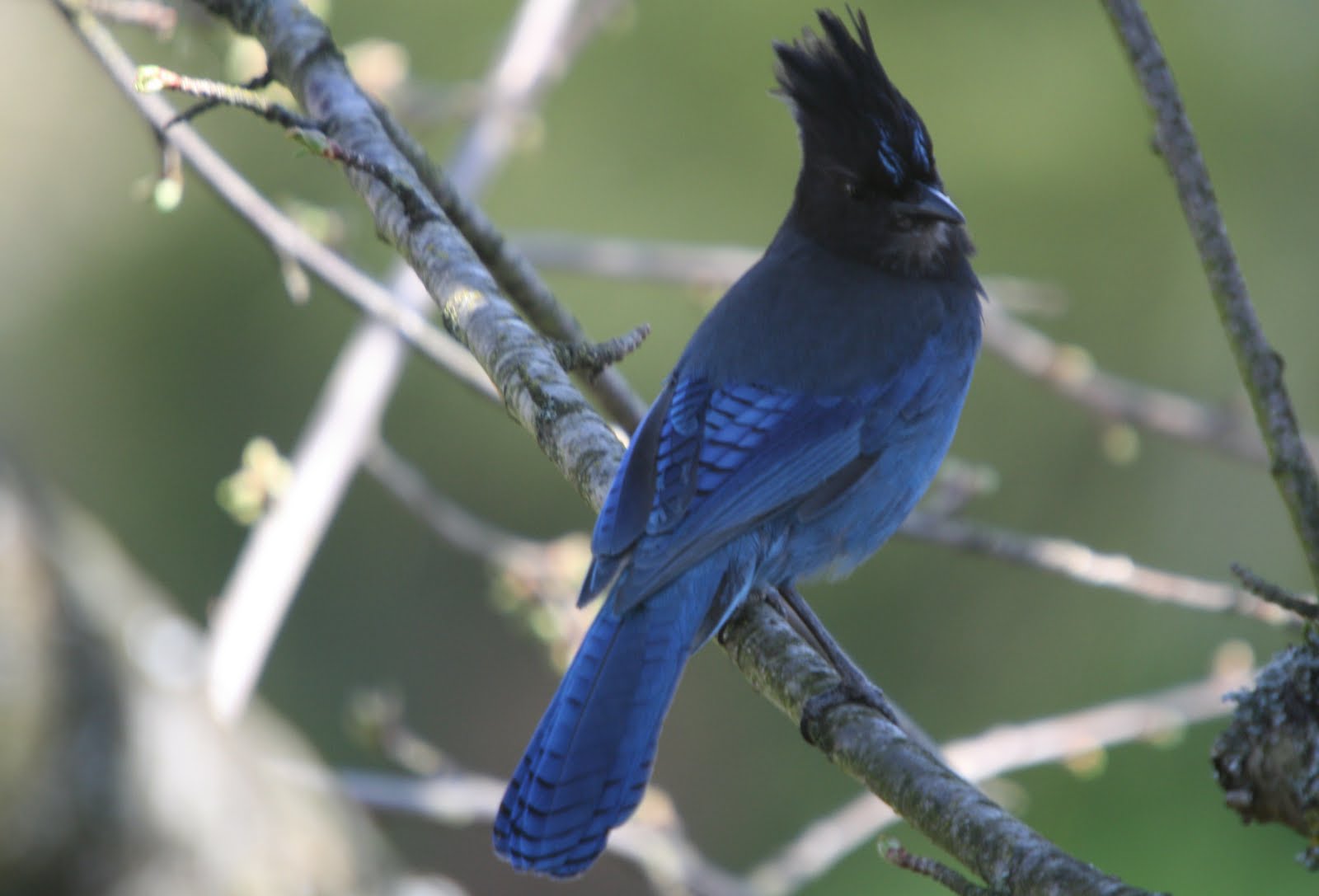
For more Stellar's Jay action, see my previous post Turf Wars
 The action in and around my front yard has been changing the last few weeks -- spring brings new visitors and familiar visitors change their behaviors.  There have been some really exciting arrivals -- especially the Stellar's Jays -- who I believe may be nesting nearby.  


But a lot of my attention -- and my camera time -- has been focused on three species who are not always well regarded:


European Starlings,


House Sparrows, 


and the Norway rat.   


Some naturalists would put these species at the top of the Public Enemies list, a kind of environmental Axis of Evil.  Others raise questions about how much they are to blame for the damage sometimes attributed to them.  Nevertheless, they are here, and no matter how much trouble they may sometimes be for us (or for competing native species), realistically they aren't going anywhere any time soon.  And whatever else they may be, they are fascinating species in their own right, with much to teach us about the adaptability and persistence of life.  


In winter, starlings are brown, covered with white speckles that fade as winter progresses. In summer, they are black with purple and green iridescence and yellow beaks. 

The European Starling is one of the most successful and widespread birds in the world.  With help from human beings, it has spread from its normal range -- which includes almost all of Eurasia, the Middle East, Northern Africa, northern India, Nepal, and parts of China -- and been "successfully" (the success here is purely from the starlings point of view, other species may characterize it differently) to North America, Australia, New Zealand and islands in the Caribbean.  In many areas where they have established themselves, they are considered pests.  They have been credited with the demise of native species, the introduction of invasive species of plants, and damage to crops and agriculture. 

They like urban areas, thriving around people.  In North America Starlings are ubiquitous, their range stretching from Mexico to Canada.  

Eugene Schieffelin (usually described as "eccentric") was the president of the American Acclimatization Society, a group which was part of an international movement to introduce interesting and "useful" species into nations where they were not native.  Some sources claim that Schieffelin wanted to introduce into America all the species that were mentioned in Shakespeare's works (Starlings are mentioned in Henry IV), but other sources question or dismiss that motivation.  What is certain though, is that Schieffelin twice -- in 1890 and 1891 -- organized the release of approximately 60 European Starlings into Central Park in New York.  The first release was considered a failure, but the second succeeded beyond all expectations.  According to The Cornell Laboratory of Ornithology's All About Birds site, all of the starlings in North America are descended from these early releases -- and the Starling population here shows remarkable genetic uniformity. 
 
What is really amazing to me, however, is the Starling's vocal ability.  In the urban neighborhood where I used to live, starlings almost seemed like smaller versions of the crows they often flocked with.  I didn't get much chance to listen to them.  Now, in a slightly more suburban neighborhood, I often stand on the deck of my house and listen to what sounds like a small chorus of birds -- sounds that range from whistles, pops, clicks and screeches, to scraps of songs that are almost familiar -- all of it emanating from one starling in the tree overhead. If you hear a bird that sounds like it is arguing with itself in multiple voices, it is almost certainly a starling.  Because they often have an "electronic" sound to their songs, I think of starlings as the re-mixers of birds, sampling and combining a wide variety of sounds into something truly their own.  A few days ago, three starlings in my yard seemed to be improvising a complex melody, with one of them providing a "base-line" that sounded for all the world like a rapper beat-boxing.  

All About Birds says that starlings are known to copy the songs of up to 20 species, including (to name only the one's common to this area) robins, Red-Tailed Hawks, and Flickers.  I'm pretty sure that the Starlings in my neighborhood have learned to imitate chickadees as well.

Starlings have been known for generations as exceptional mimics.  They can even learn human speech.  Mozart had a pet starling, and is believed to have incorporated some of its songs into his own work.  (For some interesting background on Starlings and their abilities, plus a chance to listen to Mozart's "Musical Joke" check out Starling Talk).  You can also see some examples of starlings talking and demonstrating their remarkable range here and here.  (These videos will lead you to many more if you're interested.)

Even knowing the possible negative effects of Starlings on the native ecology and the controversies surrounding them, I find myself almost every day listening to them with a kind of awe.  And I am very grateful for the chance to get to know them.

Tomorrow, I will take up the second species in the Axis of Evil -- the House Sparrow.