Showing posts with label House Finch. Show all posts

Monday, April 23, 2012

More About Finches

Last week I was speculating about the possibility of an inter-species romance in my front yard -- based on a photo I took of a male Goldfinch and a female Pine Siskin apparently hanging out together.  The two species are closely related, and interbreeding, producing hybrid offspring, is known to occur (thought not very often).  The idea set me off on a small quest for information about hybridization, avian genetics and finches.  I found some interesting stuff, but not necessarily what I was looking for.  I still have a lot of questions about inter-species matches:  How do they happen?  Why do they happen?  And so on.

But, in regards to the birds in my front yard -- at least the one's I was writing about specifically -- those questions might be moot.  Because, this past weekend, I took these photos in my front yard.


This is my male Goldfinch -- looking at the molting spots on his back and neck I was pretty sure that he was the same bird I photographed last week.  He was in the Cherry tree. 


As and aside, the Cherry Tree came into bloom this weekend, and it was busy with birds.  Even the most familiar birds look fresh in that setting.


Also hanging out in the Cherry Tree was my resident House Finch.  He actually has a small part in this story, which I'll get back to later.


The House Finch couple are one of my favorites to watch, because they sing to each other.  I understand that in most songbirds species, the singing is done by the male, but the House Finches clearly sing back and forth -- even if you can only see one of them, you can hear the response of the mate each time they sing.  It is very sweet. 


Which brings us back to the Goldfinches.  The male Goldfinch and the male House Finch were frequently in view together. 


 However, I also spotted this pretty sight in the tree.  Clearly, a female Goldfinch.


Still, there have been a number of Goldfinches around this spring, and just because she's visiting the cherry tree at the same time as my mottled male doesn't mean they're an item.  Right?

But consider this:


Here we see the Male House Finch together with both Goldfinches -- and they sure do look like a couple don't they?  I observed them for quite a while this weekend, and I think it's pretty clear that the male Goldfinch has, indeed, found himself a species appropriate mate.  I wouldn't worry too much about the Pine Siskin though -- there are plenty of males of her species around for her to hook up with.

One final shot.  Even thought you can't see all four of the birds clearly here, this is both Finch Couples on the feeder together, like Couples Night Out. The female House Finch is in the back.  It seemed like they were all having a pleasant Saturday night in the front yard.


Thursday, April 12, 2012

Birds Do It


It seems to be Finch Spring this year around my neighborhood.  Last week I mentioned the Pine Siskins who have been all over the feeders, and the familiar House Finch couple who have been handing out.  They're always together.  But this week, a new visitor showed up, wearing his bright spring time colors.  The American Goldfinch is the state bird of Washington (and a couple of other states, I believe).  I think his little black crown makes him look like Moe from the Three Stooges.


And then:


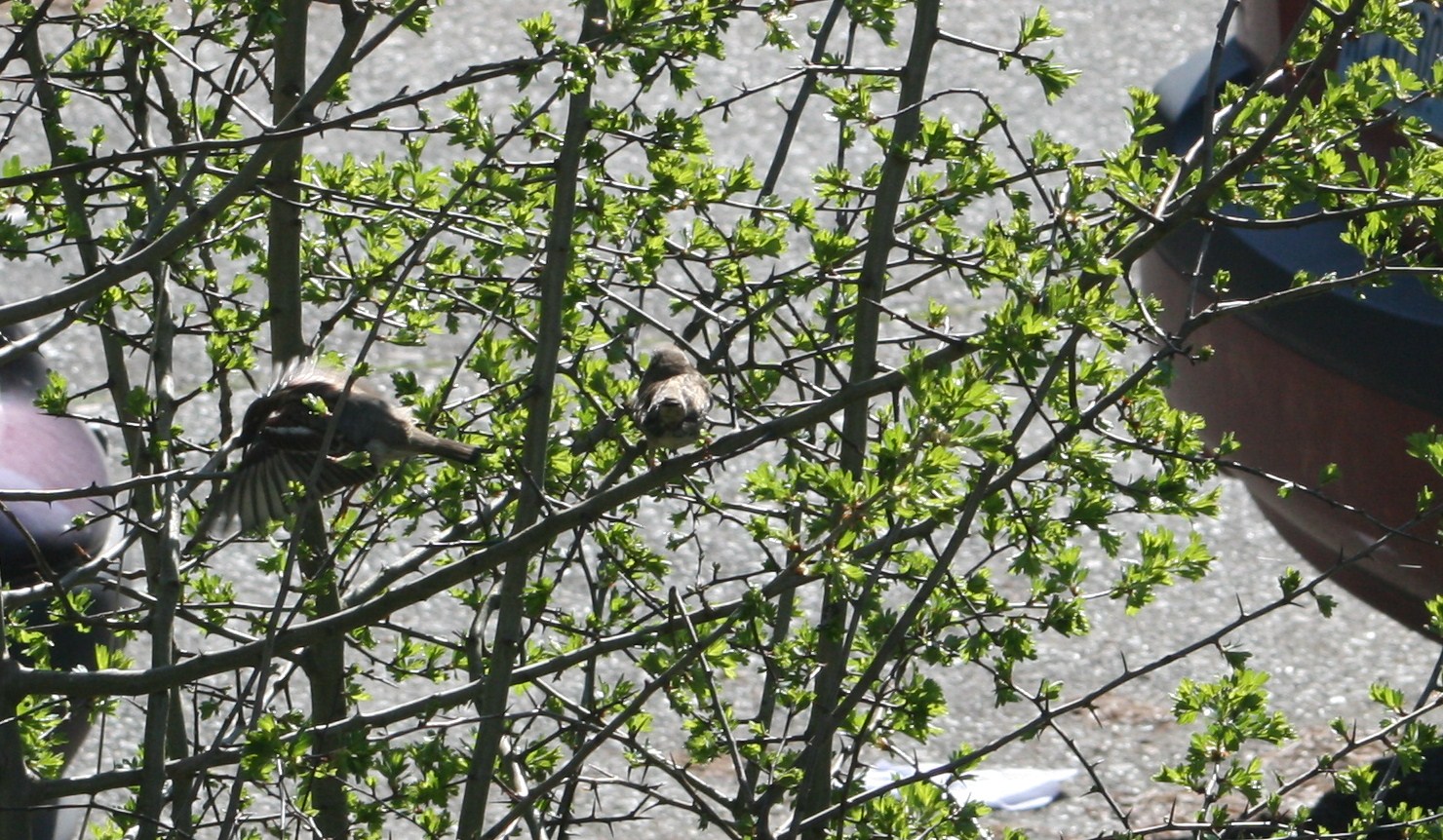
I've never watched, let along captured mating behavior in my front yard before.  These two House Sparrows are definitely working on love, though.


Next comes nesting. This photo, taken just after the courtship, shows the male Sparrow starting to gather nest materials.  He didn't seem to be too sure what to do with them though.  


Since we had House Sparrows nests nearby last year, and several fledglings at the feeders, its very likely he's doing to be building soon.


And finally, after all that excitement, it's time to eat.


###

If you like Birdland West, you might also want to check out our sister blog Books and Beasts, which focuses on reviews of books about animals and related topics.
 Many of the original photographs featured on Birdland West are available for sale as art quality prints.  You can check out all of our offerings at http://AlexWashoe.imagekind.com.  If you see an image here that does not show up on our Imagekind site please contact me directly and I'll let you know about availability.)


Tuesday, April 3, 2012

Familiar (but welcome) visitors

The nice weather this month has brought out a lot of activity in the yard.  I was on the deck yesterday and I noticed this couple on the feeder.  At first glance, I mistook the female for a Pine Siskin.  They've been so common this spring that I just expected to see them.  But then I caught a flash of red on the male, and when I looked closer I saw that both birds were too big to be Siskins, and they had shorter, heavier beaks.


I don't know if this is the same House Finch couple that hung around most of last summer -- or if this is perhaps the young male Finch who was also here last year.  As I understand it, House Finches often form new couples each year, so either or both of these birds could be new.  It's good to see them though.  I've added a finch feeder since last year, so we'll see if they visit that too.


Speaking of familiar faces, this handsome House Sparrow was also hanging out in the cherry tree.  There are a lot of sparrows around -- House Sparrows, Song Sparrows, and one Golden-Crowned Sparrow (that I blogged about recently).  I've noticed a lot of sparrow squabbling this year.  One day a tangle of three sparrows whirled right past my head as I was walking my dog.  Lots of excitement.


As I mentioned above, the Pine Siskins have been everywhere this year.  I got this photo of a small flock of them working the feeder.  


A friend of mine at the PAWS Wildlife Center told me that they have been seeing a lot of cases of salmonella in Pine Siskins this year.  So if you have Siskins around it's important to be very vigilant about cleaning the feeders.  Washing them out regularly with a weak (about 10%) bleach solution is ideal. 


Bewick's Wrens are infrequent visitors to my yard, and usually they move too fast for me to get a decent photo.  I caught this one hopping around yesterday though and was able to capture him before he disappeared.


Finally -- it just wouldn't be Birdland West without frequent visits from our Pigeon Friends.  Here is one of mine waiting on the roof for the dogs to go inside so he can come down and eat. 


Our dog Lulubelle loves to bark at the pigeons and seems to take great pleasure in scaring them off.  But they always return, usually as soon as she goes inside. 


###
If you like Birdland West, you might also want to check out our sister blog Books and Beasts, which focuses on reviews of books about animals and related topics.
 Many of the original photographs featured on Birdland West are available for sale as art quality prints.  You can check out all of our offerings at http://AlexWashoe.imagekind.com.  If you see an image here that does not show up on our Imagekind site please contact me directly and I'll let you know about availability.)

Tuesday, September 20, 2011

A Busy Day at the Bird Feeders


Yesterday, in the afternoon, the sun came out unexpectedly after a cold, rainy weekend.  The yard was glistening in a way that I usually associate more with spring than late-summer-fading-into-Autumn.  But then, we didn't get much spring in Seattle this year, so I'll take it.

Black-Capped Chickadee with his prize, perched in cherry tree.
Waiting his turn.
I don't know if it was the sunshine, the cooler, crisper temperatures or just a coincidence, but suddenly the yard was alive with birds.  Chickadees, who are always around, were out in force.  They queue up in the cherry tree and wait their turn at the feeder -- it seems to be a chickadee rule that only one bird can use the feeder at time.  Sparrows and finches and Juncos are glad to double up, but chickadees wait their turn.  Usually, the next chickadee waits on the branch above the feeder until the one who is there leaves.  They never take very long, picking out the seed they want and flying back up into the tree with it.  Every once in a while a chickadee approaches the feeder and realizes at the last minute that there's someone already there, then pulls up in a whuff of wings and lands in the tree.  But they never seem to squabble the way sparrows and other birds do.  It's all very orderly and efficient.


I wasn't the only one watching the chickadees yesterday.  Another familiar visitor was out and about.  I'm pretty sure that this is the same young House Finch that I photographed (and blogged about) earlier this summer.   


He's looking much more adult now, but he still has a tentative, uncertain air.  I didn't ever see him use the feeder, but he did sit on the chickadees' queue branch and watch them for quite awhile.  It seemed like he was observing their use of the feeder. 


 I also saw another return guest.  This Bewick's Wren was foraging in the Morning Glory vines along the fence.  I haven't seen a BW in months.


 And, the young Anna's Hummingbird that I've seen and reported on a couple of times recently was back.   In fact, I could hear her periodically throughout the day -- a rapid chirp sound like a high-pitched telegraph key -- but it wasn't until late in the afternoon (when the light was fading) that I managed to get some shots of her.


So, counting the crows who were foraging on the sidewalk and the House Sparrow at the feeder -- not counting the Starlings I could hear in the back yard or the pigeons who I didn't see until evening -- that's five species that I counted standing on my deck, without even really trying hard.  None of them were new or unusual, but it was still pretty exciting.


And just to top things off, today I was drawn outside again by the Anna's Hummingbird sound, only to find a totally different bird at the feeder.  This one, as you can see, is quite a bit larger and clearly full grown.


 If you like Birdland West, you might also want to check out our sister blog Books and Beasts, which focuses on reviews of books about animals and related topics.

 Many of the original photographs featured on Birdland West are available for sale as art quality prints.  You can check out all of our offerings at http://AlexWashoe.imagekind.com.  If you see an image here that does not show up on our Imagekind site please contact me directly and I'll let you know about availability.)


Thursday, August 11, 2011

Success at last! (Sort of)


After spending most of the summer looking for them, I finally spotted a juvenile House Finch this week.  I thought I had seen him twice before, but I didn't get a good enough look or any photos to confirm it.  Then, Sunday morning, there he was.


If you read my blog occasionally you probably know that the adult House Finches have been regular guests here throughout the year.  I was pretty sure that they were nesting nearby, and was hoping to see fledglings before the summer was done.  House Finches sometimes nest late in the summer -- in fact, they can sometimes produce two broods in a season -- but as weeks went by I began to worry that I'd missed them, or they weren't going to show this year.

So you can imagine my excitement when I finally spotted this guy.  His nascent coloring identifies him as a male, in the transitional stage to adult plumage.  I was sure that I'd finally found my Finch couple's kids.

House Finch Couple
Only, it's not quite that simple.  According to my naturalist friend, Kevin, House Finches only molt once a year, and since this guy is transitioning, the chances are he's one of last year's fledglings.  House Finches don't migrate; they stay here all year round, so it's entirely possible that he's from the same family.  Possible, but not guaranteed.  Kevin gave me a quick lesson in the family dynamics of House Finches.  Unlike many songbirds, they form new pair bond's each breeding season -- the couple I've been observing may not have been together last year, and may not pair up next year.  Also, young birds disperse, immigrating to new areas and emigrating in from other areas to mix up the gene pool.  All my House Finch friends could be from one family, or they could be totally unrelated.  Short of inviting them in for a DNA test, it's very hard to be sure. 

Still, the juvenile House Finch was on my wish list this year, and I got to see one at last.


If you like Birdland West, you might also want to check out our sister blog Books and Beasts, which focuses on reviews of books about animals and related topics.


(Many of the original photographs featured on Birdland West are available for sale as art quality prints.  You can check out all of our offerings at http://AlexWashoe.imagekind.com.  If you see an image here that does not show up on our Imagekind site please contact me directly and I'll let you know about availability.)

Monday, August 8, 2011

Around the Yard and Around the Web


Crows are geeks.

And if you have any doubt, let me offer some evidence.  This crow is clearly an "early adopter".  I photographed him this weekend helping himself to cherries in the cherry tree. 


Even though the cherries are very ripe, most of the birds haven't quite gotten around to feasting on them yet.  (Although, Saturday night, coming home from a monthly poker game, my roommate and I surprised a raccoon in the tree.  He -- actual gender unknown -- was pretty small, so I'm guessing he was one of this year's crop.  I got to see his masked face for just a second before he vanished into the shadows. )  The crow however is on top of things, and getting first jump on the cherries.


It continues to be an exciting year for fledglings and juveniles.  At least one group of House Sparrow young'uns is coming of age around my yard.  I now have photos of them at several stages of development.  I suspect that there is more than one group though, because I took some photographs of slightly older fledglings a week or so before I caught shots of younger ones. (You can see those photos here and here.)  


Saturday morning there was a juvenile House Sparrow raising quite a ruckus in the front yard.  It went on for almost ten minutes with him flitting from bush to bush.  I never did figure out what he was so agitated about, and eventually he quieted down and went back to his normal routine.  But I did get some good shots while he was pontificating.


Timmy's Friend
Timmy!
I also managed to get some good shots of my resident Pigeon Timmy, along with his frequent companion.  Timmy is the larger pigeon with the lighter colored wings.  I have also noticed a new pigeon in the neighborhood -- a thin, mostly white pigeon that I haven't seen until recently.  I'll keep an eye on this new arrival and see if I can get some photos.


The great challenge of the season, for me, remains the House Finch fledglings.  The couple has been here almost all year, and I was pretty sure they were nesting nearby, but so far I have no definitive proof of juvenile finches.  I saw some birds recently on the rail that could have been the elusive youngsters, but I didn't get a good enough look, and couldn't get any photos.  Like Captain Ahab, though, I will continue to pursue them.


Updates, Follow-ups and interesting links


I was very happy to be included in the most recent Carnival of Evolution.  If you haven't seen it (or don't know what a blog carnival is -- I didn't until recently) it is basically a regular round up of  blog writing on a certain topic -- in this case evolution, which is broad enough to include many things.  My recent post Game Show Pigeons and Ball Playing Dogs was included and I've been gratified to see a nice up-tick in viewings as a result.  If you're interested in biology, evolution, science writing or any number of related topics I suggest you check it out.  It comes out monthly and is hosted on a different blog each time.  This edition was hosted on Lawrence E. Moran's blog Sandwalk -- which is, itself, well worth checking out.  (There's even a musical interlude called "Cambrian Explosion" that you really have to see.)

There are blog carnivals, by the way, on all kinds of topics.  If you're curious, you can check out Blog Carnival to get an idea of what's out there.

One of the people who found my posting from the carnival was Roslyn Dakin, a PhD student from Kingston, Ontario.  Turns out, she also has an interest in the Monty Hall problem.  Her take is somewhat different than mine and well worth checking out.  In fact, her whole blog is very rewarding.  You can check out her Monty Hall article here, and her most recent posts here.

And, finally, there's a great article in the Grand Forks Herald recently, by Herald editor/publisher Mike Jacobs.  "Target Species Enrich Birding Experience", about the joys and expenses of having a birding wish list.  (I have a wish list -- both local and more farfetched -- which I'll be sharing in the near future.)  


If you like Birdland West, you might also want to check out our sister blog Books and Beasts, which focuses on reviews of books about animals and related topics.


(Many of the original photographs featured on Birdland West are available for sale as art quality prints.  You can check out all of our offerings at http://AlexWashoe.imagekind.com.  If you see an image here that does not show up on our Imagekind site please contact me directly and I'll let you know about availability.)


Monday, August 1, 2011

Updating the Yard LIst

Summer has finally come to Seattle and we've had a stretch of mostly dry, warm weather.  The wildflowers are blooming in the garden (which was taken over by weeds before they arrived).  And the Seattle Mariners followed up their surprisingly good first half with a club record 16 straight losses in July.  Yikes. 

But on to the wildlife. 

Sunday morning I was looking out my window and I spied an unlikely couple having breakfast together.  They're both frequent visitors to the feeders, but I've never seen them together before.  There they were, just chowing down like old friends.  I had to take the pictures through the window, because there's no way I could have gotten out on the deck without both of them taking off. They hung out for about ten minutes, not the least bit concerned with each other.
Sunday Brunch with a pal.
My dog Lulubelle routinely flushes the squirrels off the porch in the mornings.  It's impressive to see them leap into the branches of the cherry tree.  The House Finch has been here since winter.  He and his mate are here almost every day.  I haven't seen any young finches though.

Speaking of the cherry tree, it is heavy with fruit.  Most of it is beyond human reach (unless you know someone with one of those cherry picker trucks).  However, the ripe fruit usually brings a burst of bird activity.  As soon as some of the fruit begins to fall I expect to see robins and many other birds congregating in the yard.   Last year, it also brought a raccoon.  They're always around the neighborhood but we very rarely see them.  I'll be keeping my eyes on the tree in the evenings, though, hoping to get a good shot.

My second discovery was even more exciting, because it was a new species for the yard list.  Over the weekend I saw a bird with a lot of bright orange on its undersides.  I thought it might be the Black Headed Grosbeak who was here earlier in the winter, but who I never managed to get good photos of.  This time I was able to get some good shots, but when  I looked at them it wasn't the Grosbeak at all.  It was someone I've never seen in the wild before (although I've seen them a number of times at the wildlife rehab center.) 

Recognize him? (Because of the blackness of his hood and tail, I'm assuming he's male, since the females are supposed to have a greyer coloring, but I'm not totally certain about that). 


Yep, that's a Spotted Towhee.  Beautiful bird isn't he? There were actually two of them in the yard at the same time.  I don't know if they were a couple, or just buddies.  My guide says they prefer to eat off the ground, but these guys were eating at the feeder.  I guess they didn't read the guide.


With the good weather expected this week I hope to get outside a lot and find some new interesting activity to report.  


And just in cast you're interested, this is my Yard List since moving to West Seattle last summer (not counting the Red-Tailed Hawk who was mobbed by crows in the tree across the street):
      June 2010 through December 31, 2010
  1. American Goldfinch (winter plumage)
  2. American Robin
  3. Anna's hummingbird
  4. Bewick's Wren
  5. Black Capped Chickadee
  6. American Crow
  7. Dark-eyed Juncos
  8. European Starlings
  9. Northern Flicker
  10. Red-breasted Nuthatch
  11. Rock Pigeons
  12. Steller's Jay
  13. Jan 1st 2011 through June 21st 2011
  14. House Finch
  15. Song Sparrow
  16. Yellow-rumped warbler
  17. Bushtit
  18. House Sparrow
  19. Black-Headed Grosbeak
  20. Wilson's Warbler 
  21.  June 22nd 2011 through _____
  22. Rufus Hummingbird
  23. Spotted Towhee
  24.  
If you like Birdland West, you might also want to check out our sister blog Books and Beasts, which focuses on reviews of books about animals and related topics.


(Many of the original photographs featured on Birdland West are available for sale as art quality prints.  You can check out all of our offerings at http://AlexWashoe.imagekind.com.  If you see an image here that does not show up on our Imagekind site please contact me directly and I'll let you know about availability.)