Showing posts with label jays. Show all posts

Monday, September 12, 2011

The Nest Generation

Despite the belated summer weather here in Seattle -- we just went through a record setting late September spell of nine over eighty degree days (after an almost nonexistent spring and unusually cool summer) -- the birds seem to know that fall is coming and they are changing their patterns.  I've seen a couple of species back around my yard in the past week that haven't been around much during the summer.

First -- a hummingbird.  Anna's hummingbirds were frequent guests in my yard all winter.  In fact, on very cold mornings I had to keep rushing outside to make sure that the feeders weren't frozen.  I got very good at thawing them out, and keeping two in rotations, one inside the house to stay warm, one outside for the birds until it got too cold.   

I haven't seen them much this summer, though.  Which seems opposite of what you would expect.  But Seattle is a city full of flowers (a blooming city, you could say) and I suspect that the hummingbirds just had plenty of food sources and didn't need my feeders.  Now, the blooms are fading and they're coming back.

At least this little gal is.  This is an Anna's hummingbird, and though it's not easy to be sure from the photos, probably a female and very likely a juvenile.  (You don't have much scale in the photos, but if you could see her in person, and you know Anna's at all, you'd realize she's pretty small.)

(Photo by my roommate Dan)
I also saw this week -- not in my yard, but at a nearby bus stop -- a busy flock of bushtits.  These guys are frequent visitors to my yard and suet feeder, and they have also been mostly AWOL during the summer.   I was happy to see them back -- they come sweeping in with lots of activity and chirping like a sudden rain squall, and then, just as suddenly they're gone.  Off down the road to another yard.  I'll be keeping my eyes (and ears -- I frequently hear them before I see them) open for them at home.

(Photo by Dan)
(Photo by Dan)

I mentioned in my last post that I had seen a Steller's Jay eating on the rail with Timmy (my resident pigeon).  I got a few photos of him, and roommate got some more soon after.  You might not think it's the same Jay from the different angles in the photos, but I'm pretty sure he is.  And if you look closely at the photos you can see, at the corner of his bill a trace of a lighter color.  That, most likely, is the remnant of gape flanges which allow juvenile birds to open their beaks extra wide (to "gape" in other words) so that they can be fed by their parents.  In a fully mature Steller's Jay the beak is dark all the way down, with no lighter coloring visible.  That means this guy is very likely one of this year's fledglings.  It also might explain why he's on his own and looking for new sources of food.


A sad note:  One of my personal heroes passed away recently.  Sarge the Elderbull was a tireless advocate for his breed, for dog lovers (and dogs who love dog lovers) and for the welfare of shelter dogs everywhere.  You can check out this sweet remembrance of him at Stubby Dog, as well as their loving obituary.  Also, you can check out Sarge's own site at Elderbulls and his Facebook page.  Sarge was a true American hero.  Thank you to Sarge and to his human family who carry on his work.

###
You can also enjoy my recent article "Crazy Flickers" over at 10,000 Birds.  They have a great site, well worth checking out even if I wasn't included.


If you like Birdland West, you might also want to check out our sister blog Books and Beasts, which focuses on reviews of books about animals and related topics.   


Monday, May 9, 2011

Dog Days, Raven Nights

I've been sick the last few days so I haven't had much chance to get out in the yard.  Still, spring is going on and the flowers are blooming.  The cherry tree outside my living room window is in full bloom and looking very beautiful.  

Dog Days, Raven Nights
I did attend a very interesting event at Seattle's Town Hall last week.  Every once in a while you hear about a book that seems so perfect that you think it could have been written just for you.  That's how I felt when I saw the title of John and Colleen Marzluff's new book Dog Days, Raven Nights.  It's the story of two young scientists (John and Colleen) who set out to the Maine woods in search of Ravens, and who become involved along the way with dog sledding and sled dogs.  Corvids and canines in one book!

In the Company of Crows and Ravens
For those of you who don't know about John Marzluff, he teaches at the University of Washington in the College of the Environment, where he is a professor of Wildlife Biology.  He is also one of the world's leading experts on crows and other corvids.  His previous book, In the Company of Crows and Ravens, which he wrote with local artist Tony Angell (you have to check out his artwork if you never have:  here) helped spark my interest in crows and eventually other birds as well.  There's also a great episode of the PBS show Nature that focuses on his work with crows here in Seattle. (Check it out here)  He and his students have done some great experiments, tagging and recording crows to learn more about their lives.  I recommend this show to anyone who's interested in very intelligent birds.  

For the Town Hall event though, they were talking about their new book, so the focus was mostly on Ravens.  Twenty years ago, when Marzluff was a young Postdoc looking for his first job, he and his wife Colleen travelled to Maine to work with the famous biologist Bernd Heinrich (you can see my review of Heinrich's own book about the time, Ravens in Winter at our sister blog Booksand Beasts).  

Crows are omnivores, and frequently scavenge road-kill.
When I lived in Ballard, a much more urban area, crows were definitely the most dominant birds around.  In fact, in Ballard, there is a running squabble between crows and seagulls that is fascinating to watch.   Crows, in my experience (and Marzluff seems to agree with this) are almost unique among wild animals in the amount of attention they pay to human beings.  They really do seem to be curious about us, and to go out of their way to observe us and interact with us.  Marzluff believes that crows (and ravens too, and maybe some other species as well) are co-evolving with humans.  Ravens follow wolf packs and other predators in search of food, so it's very likely that they learned to follow early human groups for the same reason.  Crows are even more closely bound to us.  They have literally followed us across the continent (the American Crow -- the bird almost everyone is familiar with -- is native to the Eastern United states, but like the Virginia Opossum and the Eastern Gray Squirrel it now resides almost everywhere we do.)  Crows have become the consummate urban bird, and the stories of their intelligence and cunning are endless.

While living in Maine, Colleen Marzluff also became involved in raising and racing sled dogs.  Anyone who has ever taken a walk (or a drive) across town with me knows that I can be instantly distracted by the sight of an interesting dog.  (Okay, all dogs are interesting).  But if a Malamute happens by, you've lost my attention entirely.  Learning to drive a dog sled is one of my bucket list items.  This part of the book, as well as the fascinating descriptions of the work with the Ravens, could have been written just for me.

Steller's Jays are also members of the Corvid family.
I got to speak to Marzluff briefly at the book signing and I mentioned the frequent Raven sightings in West Crest Park, just up the hill form me here in West Seattle.  He told me that there was a pair of crows nesting on Mercer Island, which might be crossing over to West Seattle.  But he also told me that someone else had reported a pair in Lincoln Park (which is just down the hill from me).  He was very interested in learning more about any ravens nesting in this area, and so am I.  So if any West Seattle readers (if I have any) know anything more about ravens in West Crest or Lincoln Parks, or anywhere in the area, I'd love to hear from you.

Like Ravens in Winter, which is one of my favorite non-fiction books, Dog Days, Raven Nights is a wonderful book for getting a taste of what the day to day work of doing science in the field is really like.  And the book is full of sled dogs and ravens.  What more could you ask?

Related Posts

And on Books and Beasts
Ravens in Winter

(Many of the original photograph featured on Birdland West are available for sale as art quality prints.  You can check out all of our offerings at http://AlexWashoe.imagekind.com. If you see an image here that does not show up on our Imagekind site please contact me directly and I'll let you know about availability.)

Monday, April 25, 2011

The Invaders (Part One of Three)


For more Stellar's Jay action, see my previous post Turf Wars
 The action in and around my front yard has been changing the last few weeks -- spring brings new visitors and familiar visitors change their behaviors.  There have been some really exciting arrivals -- especially the Stellar's Jays -- who I believe may be nesting nearby.  


But a lot of my attention -- and my camera time -- has been focused on three species who are not always well regarded:


European Starlings,


House Sparrows, 


and the Norway rat.   


Some naturalists would put these species at the top of the Public Enemies list, a kind of environmental Axis of Evil.  Others raise questions about how much they are to blame for the damage sometimes attributed to them.  Nevertheless, they are here, and no matter how much trouble they may sometimes be for us (or for competing native species), realistically they aren't going anywhere any time soon.  And whatever else they may be, they are fascinating species in their own right, with much to teach us about the adaptability and persistence of life.  


In winter, starlings are brown, covered with white speckles that fade as winter progresses. In summer, they are black with purple and green iridescence and yellow beaks. 

The European Starling is one of the most successful and widespread birds in the world.  With help from human beings, it has spread from its normal range -- which includes almost all of Eurasia, the Middle East, Northern Africa, northern India, Nepal, and parts of China -- and been "successfully" (the success here is purely from the starlings point of view, other species may characterize it differently) to North America, Australia, New Zealand and islands in the Caribbean.  In many areas where they have established themselves, they are considered pests.  They have been credited with the demise of native species, the introduction of invasive species of plants, and damage to crops and agriculture. 

They like urban areas, thriving around people.  In North America Starlings are ubiquitous, their range stretching from Mexico to Canada.  

Eugene Schieffelin (usually described as "eccentric") was the president of the American Acclimatization Society, a group which was part of an international movement to introduce interesting and "useful" species into nations where they were not native.  Some sources claim that Schieffelin wanted to introduce into America all the species that were mentioned in Shakespeare's works (Starlings are mentioned in Henry IV), but other sources question or dismiss that motivation.  What is certain though, is that Schieffelin twice -- in 1890 and 1891 -- organized the release of approximately 60 European Starlings into Central Park in New York.  The first release was considered a failure, but the second succeeded beyond all expectations.  According to The Cornell Laboratory of Ornithology's All About Birds site, all of the starlings in North America are descended from these early releases -- and the Starling population here shows remarkable genetic uniformity. 
 
What is really amazing to me, however, is the Starling's vocal ability.  In the urban neighborhood where I used to live, starlings almost seemed like smaller versions of the crows they often flocked with.  I didn't get much chance to listen to them.  Now, in a slightly more suburban neighborhood, I often stand on the deck of my house and listen to what sounds like a small chorus of birds -- sounds that range from whistles, pops, clicks and screeches, to scraps of songs that are almost familiar -- all of it emanating from one starling in the tree overhead. If you hear a bird that sounds like it is arguing with itself in multiple voices, it is almost certainly a starling.  Because they often have an "electronic" sound to their songs, I think of starlings as the re-mixers of birds, sampling and combining a wide variety of sounds into something truly their own.  A few days ago, three starlings in my yard seemed to be improvising a complex melody, with one of them providing a "base-line" that sounded for all the world like a rapper beat-boxing.  

All About Birds says that starlings are known to copy the songs of up to 20 species, including (to name only the one's common to this area) robins, Red-Tailed Hawks, and Flickers.  I'm pretty sure that the Starlings in my neighborhood have learned to imitate chickadees as well.

Starlings have been known for generations as exceptional mimics.  They can even learn human speech.  Mozart had a pet starling, and is believed to have incorporated some of its songs into his own work.  (For some interesting background on Starlings and their abilities, plus a chance to listen to Mozart's "Musical Joke" check out Starling Talk).  You can also see some examples of starlings talking and demonstrating their remarkable range here and here.  (These videos will lead you to many more if you're interested.)

Even knowing the possible negative effects of Starlings on the native ecology and the controversies surrounding them, I find myself almost every day listening to them with a kind of awe.  And I am very grateful for the chance to get to know them.

Tomorrow, I will take up the second species in the Axis of Evil -- the House Sparrow.


Saturday, April 16, 2011

Turf Wars

In early Spring, the Cherry Tree
puts forth Robins and Jays
who disagree


Harsh screeches split the early morning air, a cacophony of loud voices from all directions.  I ran out on my deck, thinking that maybe the neighborhood crows had cornered another hawk (I'll share those pictures with you sometime, of the Red-Tail being chased out of Dodge last fall).  But when I got outside I realized that the voices were shriller and raspier than crows.  Most of them seemed to be coming from the big evergreen trees across the street.

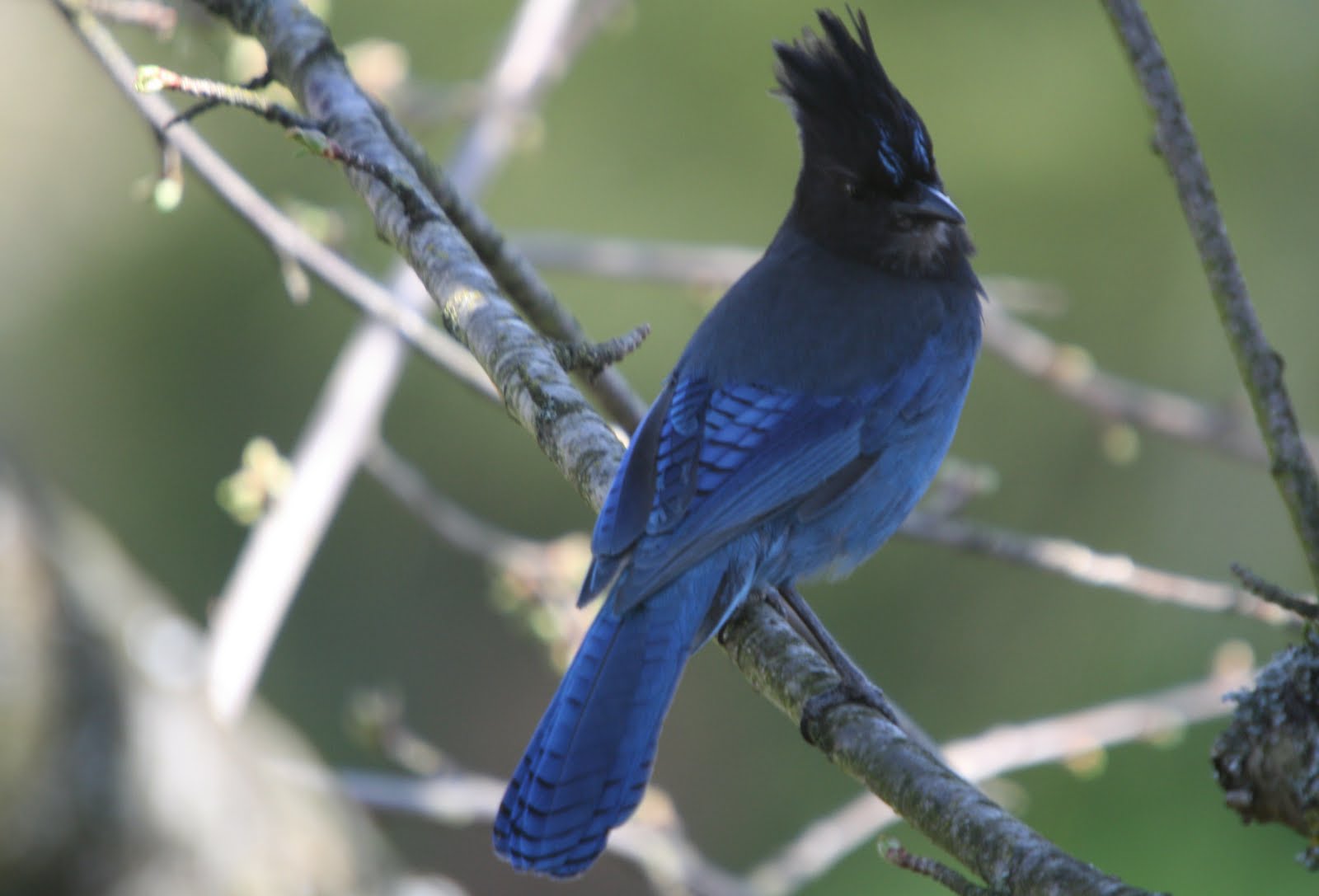
And then, there it was.  In the cherry tree over my head, a flash of the richest, dark blue you can imagine.  Dark blue with a head and crest of black.  Steller's Jays.


I hadn't seen them in months, not since the last snowfall and freeze when one stopped by our yard looking for food.  And now, here they were, all over the neighborhood.  I counted at least half a dozen, but they were flashing around so fast it was hard to tell.  At one point, there were at least three in the big cherry tree over my head.  Three Steller's Jays in my yard!


Georg William Steller was a botanist, physician and zoologist who joined  Vitus Bering's second Kamchatka expedition, which landed on Kayak Island in Alaska on July 20th, 1741.  (You can find the Wikipedia listing here).  The Captain intended to stop only long enough to take on water, but Steller insisted on having more time to explore.  They were probably the first Europeans in Alaska, and Steller went on to name (after himself) at least six species of birds and mammals.  Of those species, the only one that isn't extinct or endangered today is the bird he originally called "The Steller's Crow" -- the loud, mischievous and beautiful relative of the eastern Blue Jay whose descendents were raising such an unholy ruckus in my neighborhood just yesterday.  


Jays are Corvids, relatives of Crows, Ravens and Magpies.  Highly intelligent, social birds.  I have been privileged to see them up close at the wildlife rehab center where I volunteer.  When you go into an aviary, most birds fly away from you, up to the corners of the pen, and most songbirds naturally gravitate to the open, wire enclosed side of the pen, where there is light and fresh air.  The Jays, however, quickly learn that the door in the back is where the people and food come in, and they are often waiting for you when you open it.  They will also look you right in the eye.  Only Crows, who in the wild are much more acclimated to people, are as willing to meet a human being on equal ground.  I know it's a hopelessly subjective, unscientific reaction, but when I look into the eyes of a Steller's Jay it's impossible not to feel that there is a quick mind there, asking the same kinds of questions about me that I'm asking about them.

On this day, however, the Jays were in trouble.  They were in such a state of agitation, leaping around so fast, that it was devilishly hard to get any photos of them at all.  The first Jay I saw in the cherry tree was quickly attacked by another bird who, after a brief struggle, won the day.  The Jay retreated and I swung my camera around to get a photo of the victor.  


It was a Robin.  A fat, pugnacious robin who had driven the Jay from the yard.  Maybe because it's spring, and Jays like other Corvids, are not above raiding the nests of other birds, or maybe just because the Robins were aggravated by the Jays' obnoxious behavior.  I've seen Robins join with Crows in harassing raptors -- especially Owls in the park -- but I've never seen a solo Robin attack a larger, more aggressive bird.

That was the only actual fighting I saw, but the noise that the Jays were making up and down the street made it seem like an epic struggle was raging.  Within an hour they were all gone from the neighborhood.