Showing posts with label invasive species. Show all posts

Tuesday, April 3, 2012

Familiar (but welcome) visitors

The nice weather this month has brought out a lot of activity in the yard.  I was on the deck yesterday and I noticed this couple on the feeder.  At first glance, I mistook the female for a Pine Siskin.  They've been so common this spring that I just expected to see them.  But then I caught a flash of red on the male, and when I looked closer I saw that both birds were too big to be Siskins, and they had shorter, heavier beaks.


I don't know if this is the same House Finch couple that hung around most of last summer -- or if this is perhaps the young male Finch who was also here last year.  As I understand it, House Finches often form new couples each year, so either or both of these birds could be new.  It's good to see them though.  I've added a finch feeder since last year, so we'll see if they visit that too.


Speaking of familiar faces, this handsome House Sparrow was also hanging out in the cherry tree.  There are a lot of sparrows around -- House Sparrows, Song Sparrows, and one Golden-Crowned Sparrow (that I blogged about recently).  I've noticed a lot of sparrow squabbling this year.  One day a tangle of three sparrows whirled right past my head as I was walking my dog.  Lots of excitement.


As I mentioned above, the Pine Siskins have been everywhere this year.  I got this photo of a small flock of them working the feeder.  


A friend of mine at the PAWS Wildlife Center told me that they have been seeing a lot of cases of salmonella in Pine Siskins this year.  So if you have Siskins around it's important to be very vigilant about cleaning the feeders.  Washing them out regularly with a weak (about 10%) bleach solution is ideal. 


Bewick's Wrens are infrequent visitors to my yard, and usually they move too fast for me to get a decent photo.  I caught this one hopping around yesterday though and was able to capture him before he disappeared.


Finally -- it just wouldn't be Birdland West without frequent visits from our Pigeon Friends.  Here is one of mine waiting on the roof for the dogs to go inside so he can come down and eat. 


Our dog Lulubelle loves to bark at the pigeons and seems to take great pleasure in scaring them off.  But they always return, usually as soon as she goes inside. 


###
If you like Birdland West, you might also want to check out our sister blog Books and Beasts, which focuses on reviews of books about animals and related topics.
 Many of the original photographs featured on Birdland West are available for sale as art quality prints.  You can check out all of our offerings at http://AlexWashoe.imagekind.com.  If you see an image here that does not show up on our Imagekind site please contact me directly and I'll let you know about availability.)

Tuesday, May 3, 2011

The Invaders (Part Three of Three)


The third entry in our environmental "Axis of Evil" goes by many names.  The Brown Rat, the Wharf Rat, the Common Rat, the Norway Rat (even though his species probably originated in Asia), the Hanover Rat, and probably more.  Officially, he is  rattus norvegicus and with the possible exception of human beings, he and his kin are the most widely distributed and successful mammals on the planet.  

Rrattus norvegicus likes to forage close to his burrows and will use the same paths so frequently that visible paths develop on the ground.

There happens to be one rattus norvegicus (at least one) living under the fence in my front yard.  If you can get past the instinctive animosity some people feel toward his kind, he is actually a pretty handsome fellow.  A close relative of hamsters, gerbils, true mice and other rats, he belongs to the murroid superfamily of rodents, and collectively they occupy a wide range of habitats and have prospered on every continent except Antarctica. 


Lab rats and mice have been shown to be capable of some degree of empathy.
The Norway Rat (no one seems to be quite sure where he got that name) is the ultimate example of the creature who has learned to prosper in the world that man has built.  They have been our nemesis for as long as we've been settled, crop growing animals (it was undoubtedly the threat that rats and mice posed to grain stores that led to the unlikely alliance between humans and cats in ancient Egypt -- an alliance which is not without its own environmental costs in today's world).  He has been blamed for disease and plague and is almost the symbol of cringing, dirty lowlifes.  ("You dirty rat!")  And though living in close proximity to rats -- especially rats nurtured on the refuse of human civilization -- can be unhealthy, I don't think rattus norvegicus really deserves his unsavory reputation.  When you come right down to it, he has a lot in common with us.

Rats build elaborate systems of burrows which they like to line with shredded paper, leaves or other fibrous materials.  Depending on their population density they can be polygamous (one male rat monopolizing many females) or polyandrous (each female when she comes into heat mates with as many males as can manage).  They are highly adaptable, changing their behavior and social structure to meet changing situations.  Rats, and their cousins mice, had been shown to possess something that looks like empathy, an ability to recognize and respond to the suffering of others, especially individuals they are closely acquainted with.

Rrattus norvegicus is highly adaptable and social.
Rats are mostly nocturnal, although like the rest of their behavior they can adapt to being active in the daytime, if population densities are high, if food in plentiful and if there is little danger of predation.  They usually don't wander more than a few hundred yards from their burrows, and they favor the same paths so much that they form visible trails on the ground.  

Wherever humans have gone, rats have followed.
If you look up the Common rat on the Internet -- no matter which of his many names you use -- you will find that way more than half of the hits you find involve ways to eliminate and control rattus norvegicus. He has followed us everywhere around the world, and we have used him as a scapegoat, a lab animal, a metaphor, and even a pet.  We have crated environments in which rats thrive, but in which they also become carriers of disease.  We often seem to blame rattus norvegicus for the squalor he sometimes lives in -- which is, after all, only our refuse.  We built the dumps, the wharfs and the slums.  He only learned to live there.

The rat in my front yard, though, is living in clean dirt and eating the seed that falls from my bird feeders.  For the moment, I'm enjoying having him around.


Related Posts

Flickers, Rats and Starlings


Wednesday, April 27, 2011

The Invaders (Part Two of Three)


Male House Sparrow at my feeder.
One morning, early this Spring, I took photos of four or five different birds at my feeders within about an hour.  When I examined the photos later I realized (with a little help from a naturalist friend) that they were all sparrows.  In five photos I had both male and female House Sparrows and one solitary Song Sparrow.  I realized that a winter of observing chickadees, bushtits and hummingbirds had changed my perception of size.  The sparrows -- which had once been my definition of "small bird" -- now looked quite substantial (and the robins that showed up at the same time looked enormous).   


In Seattle, sparrows seemed to be associated closely with supermarkets.  The Safeway across the street from me in Ballard, at my old home, had numerous sparrows living in the eaves of its parking garage and nesting, come Spring, in the small trees along the sidewalk.  The QFC close to my new home in West Seattle has the same arrangement, except they have no garage, so that sparrows are hanging out under the front of the building.  I always stop to look at them on my way in.  

Female House Sparrow at my feeder.


As Spring has progressed (if Spring has progressed -- it has been a very intermittent season so far this year) the House Sparrow couple have become frequent visitors at my feeders.  The male is very handsome, with his dashing brown head stripes and direct gaze.  The female is more nondescript, but I often see the two of them together.  (Or at least, I often see a male and female House Sparrow together -- I can't be absolutely positive they're the same couple every time).  


Song Sparrow
Unlike the Song Sparrow, which is native to North America, the House Sparrow is a transplant.  They are native to most of Europe and Asia.  Among "invasive" birds, only the European Starling and the universal Rock Pigeon are more common -- and Rock Pigeons, which are all the feral descendents of domesticated birds, fall into a different category.  The first known, deliberate release of House Sparrows in North America was in Brooklyn, NY (or possibly in Central Park) in 1851.  By 1900 (according to All About Birds) it had spread as far west as the Rocky Mountains.  Although two subsequent releases, in Salt Lake City and San Francisco in the 1870's surely helped the birds get established.

House Sparrows share another trait with Rock Pigeons, they are fond of human housing, seeming to prefer eaves, attics and nest boxes.  They flourish around us.  They are often credited with evicting native species form nesting areas and are known to aggressively defend their homes from other birds.  The pair in my front yard seem to get along fine with the chickadees and juncos who frequent the feeders, but I have seen them squabble with starlings over the suet.  Both invaders seem to get their fair share (as does the rat who lives under the fence -- but more about him next time).

Male House Sparrow going for suet.
So far, the House Sparrows have been an attractive and un-troublesome addition to life in my yard.  I would guess that they are here because they are nesting nearby, and that we are far enough from their winter flock feeding grounds that we won't have to worry about inundation.  I didn't see a single sparrow here over the winter.  

We pay a lot of attention -- deservedly -- to the endangered and embattled species, and worry a lot about the effect of invasive species on native habitats.  Which we should.  But it seems to me that there is something to be learned, too, from the creatures who thrive best in the world that we have created.  After all, it's the opportunistic, aggressive, highly successful, sometimes destructive, adaptable creatures like Starlings, Song Sparrows, Crows and (yes) rats who are in many ways most like us.

Maybe that's why we're so ambivalent about them.


Monday, April 25, 2011

The Invaders (Part One of Three)


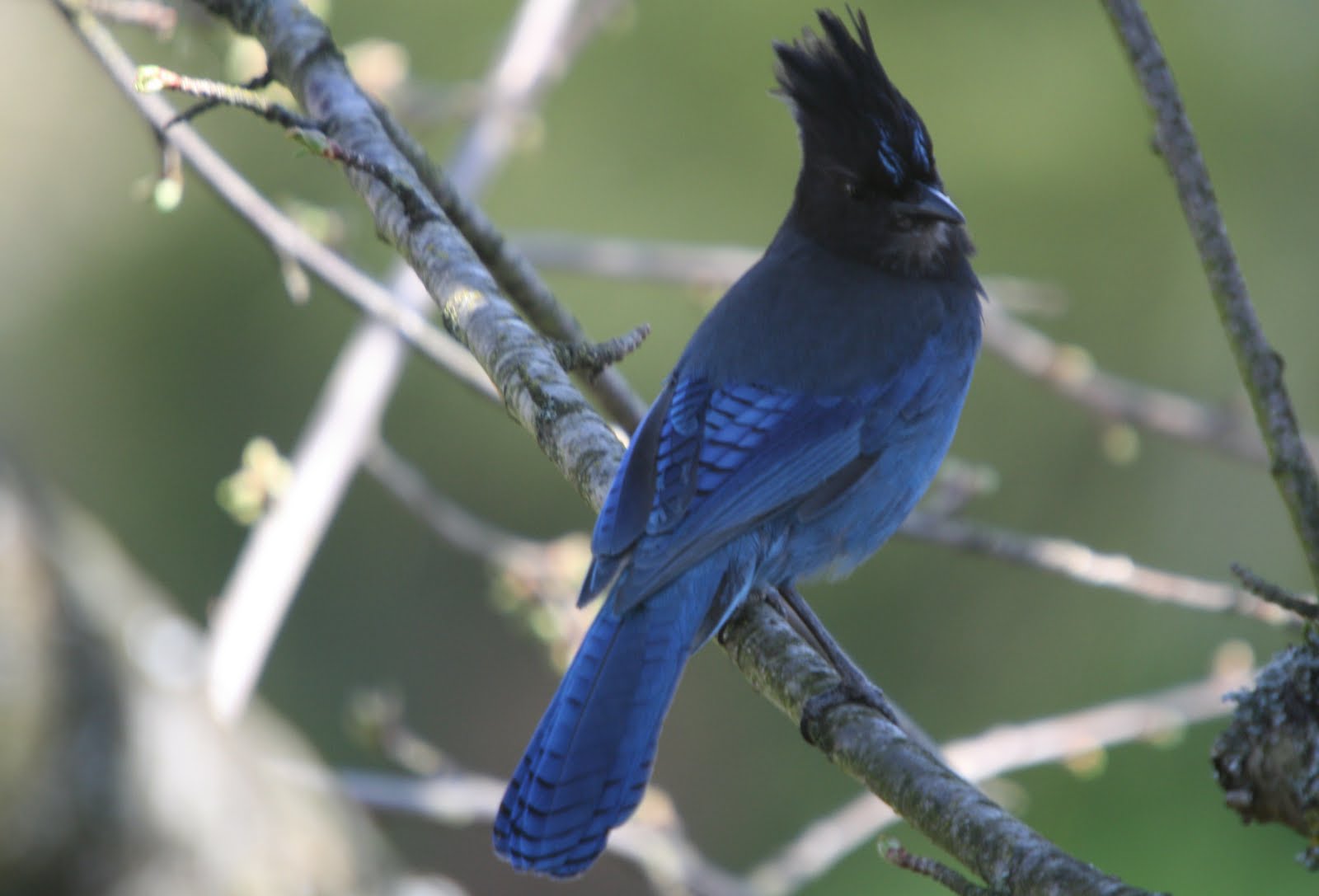
For more Stellar's Jay action, see my previous post Turf Wars
 The action in and around my front yard has been changing the last few weeks -- spring brings new visitors and familiar visitors change their behaviors.  There have been some really exciting arrivals -- especially the Stellar's Jays -- who I believe may be nesting nearby.  


But a lot of my attention -- and my camera time -- has been focused on three species who are not always well regarded:


European Starlings,


House Sparrows, 


and the Norway rat.   


Some naturalists would put these species at the top of the Public Enemies list, a kind of environmental Axis of Evil.  Others raise questions about how much they are to blame for the damage sometimes attributed to them.  Nevertheless, they are here, and no matter how much trouble they may sometimes be for us (or for competing native species), realistically they aren't going anywhere any time soon.  And whatever else they may be, they are fascinating species in their own right, with much to teach us about the adaptability and persistence of life.  


In winter, starlings are brown, covered with white speckles that fade as winter progresses. In summer, they are black with purple and green iridescence and yellow beaks. 

The European Starling is one of the most successful and widespread birds in the world.  With help from human beings, it has spread from its normal range -- which includes almost all of Eurasia, the Middle East, Northern Africa, northern India, Nepal, and parts of China -- and been "successfully" (the success here is purely from the starlings point of view, other species may characterize it differently) to North America, Australia, New Zealand and islands in the Caribbean.  In many areas where they have established themselves, they are considered pests.  They have been credited with the demise of native species, the introduction of invasive species of plants, and damage to crops and agriculture. 

They like urban areas, thriving around people.  In North America Starlings are ubiquitous, their range stretching from Mexico to Canada.  

Eugene Schieffelin (usually described as "eccentric") was the president of the American Acclimatization Society, a group which was part of an international movement to introduce interesting and "useful" species into nations where they were not native.  Some sources claim that Schieffelin wanted to introduce into America all the species that were mentioned in Shakespeare's works (Starlings are mentioned in Henry IV), but other sources question or dismiss that motivation.  What is certain though, is that Schieffelin twice -- in 1890 and 1891 -- organized the release of approximately 60 European Starlings into Central Park in New York.  The first release was considered a failure, but the second succeeded beyond all expectations.  According to The Cornell Laboratory of Ornithology's All About Birds site, all of the starlings in North America are descended from these early releases -- and the Starling population here shows remarkable genetic uniformity. 
 
What is really amazing to me, however, is the Starling's vocal ability.  In the urban neighborhood where I used to live, starlings almost seemed like smaller versions of the crows they often flocked with.  I didn't get much chance to listen to them.  Now, in a slightly more suburban neighborhood, I often stand on the deck of my house and listen to what sounds like a small chorus of birds -- sounds that range from whistles, pops, clicks and screeches, to scraps of songs that are almost familiar -- all of it emanating from one starling in the tree overhead. If you hear a bird that sounds like it is arguing with itself in multiple voices, it is almost certainly a starling.  Because they often have an "electronic" sound to their songs, I think of starlings as the re-mixers of birds, sampling and combining a wide variety of sounds into something truly their own.  A few days ago, three starlings in my yard seemed to be improvising a complex melody, with one of them providing a "base-line" that sounded for all the world like a rapper beat-boxing.  

All About Birds says that starlings are known to copy the songs of up to 20 species, including (to name only the one's common to this area) robins, Red-Tailed Hawks, and Flickers.  I'm pretty sure that the Starlings in my neighborhood have learned to imitate chickadees as well.

Starlings have been known for generations as exceptional mimics.  They can even learn human speech.  Mozart had a pet starling, and is believed to have incorporated some of its songs into his own work.  (For some interesting background on Starlings and their abilities, plus a chance to listen to Mozart's "Musical Joke" check out Starling Talk).  You can also see some examples of starlings talking and demonstrating their remarkable range here and here.  (These videos will lead you to many more if you're interested.)

Even knowing the possible negative effects of Starlings on the native ecology and the controversies surrounding them, I find myself almost every day listening to them with a kind of awe.  And I am very grateful for the chance to get to know them.

Tomorrow, I will take up the second species in the Axis of Evil -- the House Sparrow.