Showing posts with label birds. Show all posts

Thursday, April 12, 2012

Birds Do It


It seems to be Finch Spring this year around my neighborhood.  Last week I mentioned the Pine Siskins who have been all over the feeders, and the familiar House Finch couple who have been handing out.  They're always together.  But this week, a new visitor showed up, wearing his bright spring time colors.  The American Goldfinch is the state bird of Washington (and a couple of other states, I believe).  I think his little black crown makes him look like Moe from the Three Stooges.


And then:


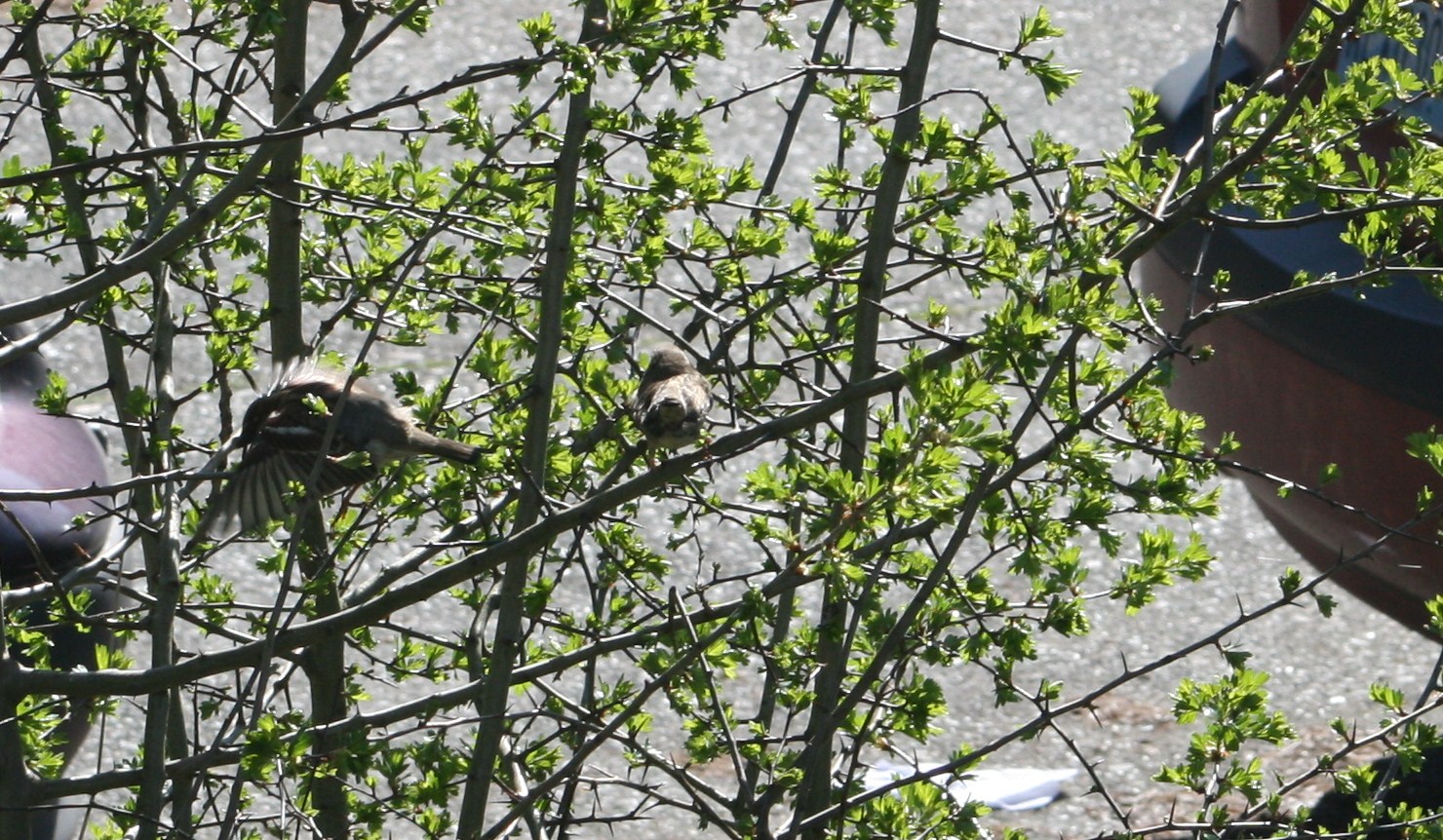
I've never watched, let along captured mating behavior in my front yard before.  These two House Sparrows are definitely working on love, though.


Next comes nesting. This photo, taken just after the courtship, shows the male Sparrow starting to gather nest materials.  He didn't seem to be too sure what to do with them though.  


Since we had House Sparrows nests nearby last year, and several fledglings at the feeders, its very likely he's doing to be building soon.


And finally, after all that excitement, it's time to eat.


###

If you like Birdland West, you might also want to check out our sister blog Books and Beasts, which focuses on reviews of books about animals and related topics.
 Many of the original photographs featured on Birdland West are available for sale as art quality prints.  You can check out all of our offerings at http://AlexWashoe.imagekind.com.  If you see an image here that does not show up on our Imagekind site please contact me directly and I'll let you know about availability.)


Tuesday, April 3, 2012

Familiar (but welcome) visitors

The nice weather this month has brought out a lot of activity in the yard.  I was on the deck yesterday and I noticed this couple on the feeder.  At first glance, I mistook the female for a Pine Siskin.  They've been so common this spring that I just expected to see them.  But then I caught a flash of red on the male, and when I looked closer I saw that both birds were too big to be Siskins, and they had shorter, heavier beaks.


I don't know if this is the same House Finch couple that hung around most of last summer -- or if this is perhaps the young male Finch who was also here last year.  As I understand it, House Finches often form new couples each year, so either or both of these birds could be new.  It's good to see them though.  I've added a finch feeder since last year, so we'll see if they visit that too.


Speaking of familiar faces, this handsome House Sparrow was also hanging out in the cherry tree.  There are a lot of sparrows around -- House Sparrows, Song Sparrows, and one Golden-Crowned Sparrow (that I blogged about recently).  I've noticed a lot of sparrow squabbling this year.  One day a tangle of three sparrows whirled right past my head as I was walking my dog.  Lots of excitement.


As I mentioned above, the Pine Siskins have been everywhere this year.  I got this photo of a small flock of them working the feeder.  


A friend of mine at the PAWS Wildlife Center told me that they have been seeing a lot of cases of salmonella in Pine Siskins this year.  So if you have Siskins around it's important to be very vigilant about cleaning the feeders.  Washing them out regularly with a weak (about 10%) bleach solution is ideal. 


Bewick's Wrens are infrequent visitors to my yard, and usually they move too fast for me to get a decent photo.  I caught this one hopping around yesterday though and was able to capture him before he disappeared.


Finally -- it just wouldn't be Birdland West without frequent visits from our Pigeon Friends.  Here is one of mine waiting on the roof for the dogs to go inside so he can come down and eat. 


Our dog Lulubelle loves to bark at the pigeons and seems to take great pleasure in scaring them off.  But they always return, usually as soon as she goes inside. 


###
If you like Birdland West, you might also want to check out our sister blog Books and Beasts, which focuses on reviews of books about animals and related topics.
 Many of the original photographs featured on Birdland West are available for sale as art quality prints.  You can check out all of our offerings at http://AlexWashoe.imagekind.com.  If you see an image here that does not show up on our Imagekind site please contact me directly and I'll let you know about availability.)

Monday, March 26, 2012

Where You Least Expect Them


After a protracted struggle (it actually snowed on St. Patrick’s Day at my house!) Spring seems to be gaining the upper hand around Seattle.  The last few days have been wonderful – and I’ve gone on two long walks with my dogs this week.  Good to be out and about again.  If you go back and look at my posts from last year, you might see that I was quite enthusiastic about the prospects of winter birding.  Unfortunately, it didn’t live up to its promise – not because nature wasn’t cooperating, but because I got wrapped up in other things and let the winter pass without enough observation.  Those “other things” – including an emotionally demanding writing project, ending one business and planning another – were all important.  But I disappointed myself with my unwillingness to brave the cold and dark in search of birds.
Anna's Hummingbird

The one bright spot throughout the winter was my hummingbird feeder.  The Anna’s not only stayed all winter (through snow and storm) but there were more of them here than I’ve ever seen.  One combative little guy staked out our tree and yard as his territory and defended them bravely, but that didn’t stop others from making a run at the feeder whenever they could.

A couple of days ago, I was out on my porch with my roommate and the dogs, enjoying the novelty of sun, when I noticed a hummingbird on the feeder.  It was one of those sights that have become so common I almost passed over it.  But something didn’t seem right.  

My roommate saw it too.  “That doesn’t look like the same hummingbird,” he said.  

This hummingbird – obviously a male – was smaller, and his coloring wasn’t quite right.  I ran inside to get my camera, but by the time I got back he was gone.  I’m pretty sure he was the first Rufous Hummingbird of the new season, back just a little early from his winter in Mexico.  I will be watching for him now, and hoping to get photos.

“Look for surprises among what you take for granted” seems to be the theme so far this year.  There is no more ubiquitous bird in my neighborhood than the Black-Capped Chickadee.  I see them all the time, and as much as I love them, it’s easy sometimes to almost stop seeing them.  When I have the camera, I often think, “One more photo of a chickadee – you have thousands.”  Which is true, I do.  Still, I’ve found surprises hiding among the chickadees before.  A couple of years ago, I found Nuthatches in the chickadee flock in my yard.  So when I started seeing flashes of brown I thought that’s what it must be.

But it wasn’t.

Chestnut-Backed Chickadee
A friend who was visiting watched the feeders with me for a few minutes.  I mentioned the brown interlopers and suggested there might be nuthatches in the flock again.  He wasn’t convinced.

“Those are definitely chickadees,” he said.

Chestnut-Backed Chickadee
He was right.  The next day I started to get photos, and they were definitely chickadees.  Just not Black-Capped Chickadees.  For some reason I had the idea that Chestnut-Backed Chickadees were usually found only in the woods, not around neighborhoods or urban parks.  I was wrong about that.  I asked my naturalist friend and he assured me it was quite common for them to form mixed flocks with Black-Capped cousins in the spring and early summer.  But I’m pretty sure I’ve never seen them in my yard before.  

Pine Siskin
 The same holds true for the Pine Siskins I wrote about in an earlier post.  I’ve seen them around Seattle, but they’ve never been common in my neighborhood – until this year, when they’re everywhere.  Change, it would seem, is in the air.
Pine Siskins


So, encouraged by the new discoveries, I spent a little more time on the deck this past week, and snapped a lot of photos.  I found some familiar, but entertaining fellows – like this puffed up House Sparrow, and a much shier Song Sparrow.  But once again, it was a case of finding the unexpected among the most familiar.  When I looked through my sparrow photos, I found this.

Do you know who this is?

I had to get help with this ID, but if you said “Gold-Crowned Sparrow”, you’re right.  It’s a juvenile, born last year and almost ready to molt into his full adult plumage.  There’s no chance at all that I would have spotted him with my naked eye.  

So far this year, I’ve added four species to the yard list (Gold-Crowned Sparrow, Pine Siskin, Chestnut-Backed Chickadees, and Cooper’s Hawk) and three to my lifetime list (Snow Goose, Chestnut-Backed Chickadees and Gold-Crowned Sparrow).  

Not a bad start at all.

(And I’ll get back to that hawk very soon.) 


 ###

If you like Birdland West, you might also want to check out our sister blog Books and Beasts, which focuses on reviews of books about animals and related topics.
(Many of the original photographs featured on Birdland West are available for sale as art quality prints.  You can check out all of our offerings at http://AlexWashoe.imagekind.com.  If you see an image here that does not show up on our Imagekind site please contact me directly and I'll let you know about availability.)

Tuesday, March 6, 2012

A Newcomer to the Yard List Takes Over Fast

Anyone who has lived in the Pacific Northwest for very long knows that spring can be a little -- unpredictable.  But this year, winter and spring seem to be engaged in a protracted slap-down, and it's still not clear who will be the winner.  Today is a perfect example:  when we woke up this morning, there was snow on the ground!  Snow! On March 6? And now, it's a bright, sunny day outside (cool and windy to be sure).  We seem to be alternating seasons every day, one nice, one cold and dark. 

But the natural world doesn't seem confused.  I was in the park a few days ago with my dog Zeke and the pink cherry trees were putting out blossoms.  And the bird activity in my yard has been frantic.  Of course, my yard is very active all winter -- I often have more birds around in the winter than I do in the summer and autumn -- but the last couple of weeks it's been very busy.  My birdseed budget has more than doubled!

This year, there's something new and interesting going on. About three weeks ago I noticed an unusual pair of birds in my yard.  I spotted them a couple of times but couldn't get photos.  So I wasn't sure if it was someone new.  Then, I got these shots -- see if you can identify them before I tell you.


Yep, those are Pine Siskins -- not showing their full summer plumage yet, but you can see the faint yellow on the wings and tails (not so well in the photo).  They were new to the yard list, and I thought it was just a pair of them.   


But no.


Suddenly, there's a whole flock of Siskins in my yard.  And unlike the chickadees who grab a few seeds and move on, these guys are occupying the feeders.  Almost every time I go out now, there's a Siskin sitting on one or both of the feeders.  Sitting there, eating or not, until another comes along and convinces him to give up the perch. 


Pine Siskins are Finches, and according to “All About Birds” they are very nomadic, and it’s not uncommon to have a flock in your yard one year and not the next.  In fact, every few years they make “irruptions” into the east and south.  They also have adaptations to allow them to survive in extreme temperatures – they can “ramp up” their metabolisms, even accelerating their heartbeat as much as five times the normal rate, to help them get through cold nights.  And they put on half again as much winter weight as close relatives like the Goldfinch.  Judging from how much seed they’ve been eating at my house, I can understand why.  But that’s not all – they store seed that totals up to 10% of their body weight in their crop. 
Little Gluttons for sure.

The last time I was at the birding store, I picked up an easy Finch Feeder -- it’s basically a net bag filled with Nyjer seed -- to hang up.  Sure enough, the Siskins have been eating there too.  I'm not completely sure there aren't some other Finch species hiding among the Siskins, but I don't proof of it.

So, for the moment, I'm just waiting to see what's going to happen.  What brought the flock here this year, when I've never seen them in the yard before?  I'm not sure.  How long will they stay?  Well I would expect them, in the not too distant future, to begin to break up into mating pairs and spread out to nest.

But for the moment, they're Kings of the Yard.


###

If you like Birdland West, you might also want to check out our sister blog Books and Beasts, which focuses on reviews of books about animals and related topics.


(Many of the original photographs featured on Birdland West are available for sale as art quality prints.  You can check out all of our offerings at http://AlexWashoe.imagekind.com.  If you see an image here that does not show up on our Imagekind site please contact me directly and I'll let you know about availability.)

Wednesday, January 4, 2012

CSI: Pigeon Town


Not the bird from last week, a young Cooper's Hawk from a nearby park last winter.
About mid-morning last Friday, while I was working at my desk in the back of the house, I heard a crow in the front yard screeching his displeasure at something.  It went on for several minutes, and I thought about going out to see what was bothering him -- following the lead of agitated crows usually leads to something interesting -- but this was only one crow, not a mob, and I was focused on the blog post I was writing, so I didn't get up.  A few minutes later my roommate Dan called me, from the front yard.  He had just gotten home, and he was whispering into his cell phone, "Dude, get the camera.  There's a small hawk in the tree outside.  Hurry."

I got the camera (which is not stored conveniently on the table by the door any more, since my dog Zeke decided to chew up one of my lenses) but by the time I got to the window, the hawk had noticed Dan and taken off.  I didn't get to see him.  However, Dan paged through the field guide and quickly identified him as a Cooper's Hawk.  That made sense, because I know there are Cooper's Hawks in this area.  I've seen them more than once in the park where I take Zeke to play.  I was mildly disappointed that I didn't get to see him myself, since I've never actually seen a hawk in our yard.

A few hours later, we were getting ready to go shopping, and Dan took the dogs out before we left.  I followed him a few minutes later and he told me, "Don't look over the side rail.  There's been a death."
My first thought was that it must be one of the rats that live under the fence.  I haven't seen them in a while, and I've been a little worried about what happened to them.  But unfortunately, this was a death that hit even closer to home.

It was one of the pigeons.

Anyone who reads my blog probably knows that I am fond of pigeons.  I take care of the little collection of "misfit" pigeons who hang out in this neighborhood -- mostly because they are centered around Timmy.  I have a history with Timmy, and feel some responsibility for him.  And I enjoy watching the pigeons when they come to eat (and often squabble) on my front deck.  They don't hang around here otherwise -- even Timmy has stopped hanging around much other than mealtimes -- so they aren't a nuisance to me or the neighbors.  I often see them perched on the power lines behind the house, watching.  When I put food down they begin to swoop in.
The "victim", fortunately, was not Timmy or Timmy's Friend.

The dead pigeon was not Timmy, or "Timmy's Friend".  (You can see my earlier posts about Timmy and the other pigeons here and here.)  In fact, judging by the wing patterns, it wasn't a pigeon I was familiar with.  I examined the body and the "crime scene" -- and I took lots of photos, which I'm going to spare my readers, since they are pretty gruesome.  Suffice it to say that the pigeon was apparently eating on the rail when it was attacked.  It looks like it was killed almost instantly, because it was on the ground just below the rail.  Its head was gone, and its crop was still filled with undigested seed which it had obviously just eaten.  There were blood and feathers around the body, and more at another spot a few feet away, under the stairs.

My first thought was that a cat was the culprit.  There are occasionally free roaming cats in our neighborhood, and any bird lover has to be concerned.  I put off bird feeding for many years because the area I used to live in -- Ballard -- was full of feral and semi-feral cats.  Don't get me wrong, I'm not anti-cat.  But I am anti-outdoor cats.  At the wildlife center where I volunteer, a very large percentage of all the animal injuries that come in -- especially birds -- are cat attacks.  Outdoor cats are an environmental horror story.  But I'll come back to that in a later post.

It didn't even occur to me, at first, that the Hawk killed the pigeon.  But of course, that was the most likely scenario.  So I sent my crime scene photos off to my friend Kevin, who's the staff naturalist at Paws WildlifeCenter.  Here's what he said:

"From looking at the photos of the pigeon, I would say you are looking at the work of a hawk, rather than the work of a cat.  First of all, it looks like the pigeon’s tail and rump feathers are intact.  In almost all cat attacks you will see wounds over the rump and missing tail feathers because the cat attacks from behind as the bird tries to fly away.  Hawks usually hit much farther forward on the body.  Once they have a good grip on their prey, they kill it by biting through one of the cervical vertebrae at the back of the neck.  They then tend to eat from the head down.  Hawks pluck the feathers from the area in which they wish to feed.  This leaves a scattered pile of loose but completely intact feathers.  Cats bite into birds right through the feathers. Feathers are generally pulled away in clumps, usually with skin still attached, and the feathers themselves are often broken or otherwise damaged.  The loose feathers around this pigeon’s body all look like they have been individually plucked, again indicating a hawk rather than a cat."
Sad news.  But on the other hand, I had a Cooper's Hawk lunching in my yard.


###

If you like Birdland West, you might also want to check out our sister blog Books and Beasts, which focuses on reviews of books about animals and related topics.


(Many of the original photographs featured on Birdland West are available for sale as art quality prints.  You can check out all of our offerings at http://AlexWashoe.imagekind.com.  If you see an image here that does not show up on our Imagekind site please contact me directly and I'll let you know about availability.)


Sunday, November 6, 2011

Accepting the Birds that Come

It is currently 39 degrees and sunny in Seattle, but I'm sitting here at my desk in a heavy coat because my dogs want to have access to the front deck.  Sigh.

Long ago, when I was an art student, studying drawing and photography, I learned a valuable lesson:  don't wait for the perfect subject, draw what's in front of you.  It seems like an easy principle to master, but it turns out it's one of those things you have to learn over and over again.

Starling and Sparrow, familiar visitors, in an uncommon mutual pose.
Take birds, for example.  As a birdwatcher, and as a photographer, I am always hoping for the next big, unexpected find.  For some rare (or at least previously unseen) bird to fly onto my yard list, or alight on the bushes at the dog park.  Of course, the definition of "rare" means that it's something which very seldom happens.  So the artist who waits for "rare" subjects -- unless he takes off for Tahiti like Gauguin -- may have a long wait.  (I couldn't come up with Paul Gauguin's name to save my life just now, so I Googled "Tahiti Artist" and it was the first hit -- I love the Internet.)  There are days when I take my camera outside and I think, "Nothing here but more chickadees, Juncos and pigeons.  I have thousands of pictures of them, why do I need more?"

Beautiful rich colors make this Junco stand out.
The answer is, "I don't."   But I need to take more pictures of them.  It's not the end product, it's the process.  That may sound like a cliche, but it's true.  Most basically, because it keeps your skills and your eye sharp -- the way practicing scales keeps a musicians hands limber and ears tuned.  But it's also true for a couple of other reasons (that I know how to articulate).

First, is receptivity.  As an artist -- photographer, writer or birdwatcher -- receptivity is one of the most important traits you can possess.  (Reactivity is another, but I'll write about that some other day.)  You could compare it to the chemical nature of film (remember film?  If you're too young, Google it).  The chemicals on the film are sensitive to light and they react in its presence, creating an image.  Similarly, the artist has to be available to the "light" of the world around him, has to let it in and let it change him.  The inner film develops these images, stores them, and they become the raw material out of with art is created.  Standing on my deck, with my camera, I am at my best when I can cultivate a state of open receptivity.  If I was religious I could phrase it as, "Not my will, but yours be done."  In other words, I will accept what comes. I'll photograph what's in front of me instead of complaining that I don't get anything "new".  Out of that openness comes possibility, the chance for something unexpected and creative to occur.  Without that openness, nothing is possible.
A distinctive mostly white Pigeon surveys the deck.

I love pigeons!
Henry James -- not usually one of my favorite writing mentors, but you really can't escape his influence -- advised us to strive to be someone on whom nothing is lost.  The emphasis on striving (James said, "try" but it's the same point) is important.  It's a goal we can't reach.  Still, it's crucial.  As soon as I begin thinking, "Oh, they're just chickadees, just pigeons, I've seen them a thousand times before," then the doors of my perception are closed.  The world is being lost on me.  The chickadees that I see today may or may not be the actual birds I've seen before -- it's very difficult to tell.  (Actually, sonograms of the songs of individual birds can help you identify whether the particular birds in your yard are the ones you've seen before -- another topic to get into later.)  With pigeons it's a little easier.  I saw four pigeons on my deck yesterday and, because I forced myself for a moment to put down all the things I was worrying about and everything I "should" be doing, I got some really great photos of them.  Two of them I knew and two were really striking, mostly white birds that I'm not sure I've seen before.  I love pigeons, but familiarity can blunt even our greatest passions.  Only openness and receptivity -- being the present moment without any certainties -- can reignite that love.  My pigeons reminded me of that.
Like the Four Stooges having lunch.

And ultimately, the birds that I see today are not the birds that I've seen before -- and I am not the person who saw them.  A photographer knows that from moment to moment the light moves and the image changes.  The photographer changes too.  No amount of clinging to my opinions or preferences will prevent that.  Tomorrow, the birds will be different and I will be different.  The tree will have a few less leaves, the monster dog on the deck beside me will be a little bigger, and the light will keep moving.


And the pigeons will have something new to say.


 ###

 I've been a little busy this month doing NaNoWriMo and other writing related activities.  So far, it's been a pretty good year for writing.  If you're interested, you can check out some of my other work.  Starting with our sister Blog, Books and Beasts.  Also, the Seattle Mariners Blog, Sodo Mojo has been hosting my posts every Sunday morning for a couple of months.  You can check out some of my pieces (and the great baseball analysis of the rest of the site's writers) here. 


Many of the original photographs featured on Birdland West are available for sale as art quality prints.  You can check out all of our offerings at http://AlexWashoe.imagekind.com.  If you see an image here that does not show up on our Imagekind site please contact me directly and I'll let you know about availability.)


Friday, October 7, 2011

Anna's Hummingbird

[Today's post marks something new from Birdland West.  I want, from time to time, to post experiments in fictional technique, short stories or sketches that attempt to bring more of the non-human world into fictional forms.  At this moment, this all experiment and feeling my way forward in the dark.  I hope that readers will offer feedback and ideas in response.]


The hummingbird hung motionless, except for its furious wings, above the feeder.  The red plastic -- a human would have called it red -- glowed like a beacon in the bird's vision, reflecting parts of the spectrum no mammal could see.  Light glinted off the bird's feathers which broke it apart like millions of tiny prisms, throwing flashes of green and red.  (Again, green and red as humans would see them -- with their primate color vision, recently recovered in evolutionary time, and so limited as compared to the bird's).  The hummingbird poised above the feeder.

Almost no one noticed.  The writer -- who lived in the house attached to the yard where the feeder hung -- was uncommonly aware of the sounds of the bird's presence -- the high pitched, fast sound, like a telegraph key -- but the weather was growing cold and the doors and windows of his house were shut.  Besides, he was preoccupied with work (or with the distractions that kept him from working).  And he was thinking about a young woman he had recently become interested in and what seemed like the impossibility that she could be interested in (old, fat, unsuccessful) him.  He didn't hear the hummingbird's approach or sense it hovering over the feeder in the bush at the front of the yard.

Across the street, a woman had just come out of her split-level home, carrying her son in her arms.  He had just turned a year old and was large for his age, with a thick tassel of very dark hair and dark eyes.  His mother looked as if she could barely hold him.  She was from China, but spoke English with only the barest trace of an accent, having lived in Europe for years before the US.  The writer, who was probably old enough to be her father, thought she was beautiful.  Her son was moody, and sometimes when he cried she would bring him across the street to the sidewalk outside the writer's house to look at the writer's dogs -- especially the huge St. Bernard mix puppy who liked to hang out on the front deck in all kinds of weather.  He was oblivious to cold or rain or snow.  Children loved him, with his goofy face and harlequin colors.  He would stand up on his hand legs and put his paws on the rail and the little boy's fussing would turn to laughter.  He would point and laugh.  The funny dog was too big and rambunctious to play with small children though.  Ironically it was the older dog, a female pit bull two thirds the size of the clown dog -- the type of dog that some people crossed the street to avoid -- who was really good with children.  She understood that they were like puppies.

The little girl who lived three houses down also loved the dogs.  She was a few months older than the boy, much smaller, but already walking.  Running.  Her mother -- tall, slim and unselfconsciously lovely -- was always chasing her up and down the sidewalk.  They were a Mormon family, the mother and father had met at Brigham Young University, moved here because of his work, and were renting a house on the block until they could find one of their own to buy.  The little girl was fearless.  She would run down the sidewalk, and back down the stairs into people's yards.  Once, she had started climbing the steps to the writer's deck with the clown-dog, who outweighed her by three times or more -- at the top of the stairs, behind the gate barking.  Whenever she saw the dogs she would point and squeal.  Her mother believed her first word had been "dog".

But today the sky was gray and the mood was drizzly.  The writer's door was closed and the dog's were inside.  The mother, struggling with her son's weight, sighed and headed off down the sidewalk, hoping a little more walking would ease his mood.

She didn't see the hummingbird.

In the cherry tree, which grew in a neighbor's yard but overhung the writer's yard, chickadees were queuing up to take their turn at the brass feeder which swung from one of the lower branches.  They leapt from branch to branch, their sharp black and white markings standing out when they landed in the light.  Chicka-dee-dee.   Chicka-dee-dee. Their call had a wheezy sound and the writer often whistled, absently, a rough approximation of the tune.  Nothing any chickadee would recognize.  The little birds seemed almost fearless, and they would sit on the feeder and look into the eyes of a person standing on the stairs only a few feet away.  They could, with a little patience, have been coaxed into eating out of the writer's hand.  They would even scavenge seed off the boards of the deck while the clown dog lay close by, watching.  They were smart enough not to try that with the older dog.

Suddenly, a young grey squirrel raced up the trunk and out along one of the branches.  Chickadees, startled by the sudden movement, dived upwards into the air.  The squirrel leapt heavily off the swaying branch and landed on the rail of the porch, where seed had been scattered (by the writer) for the pigeons and other birds, like the Juncos who preferred to eat off the ground or rail instead of a feeder.  Just as often, though, it was the squirrels who ate it, or one of the rats that lived in burrows underneath the fence.

Inside the house, the clown-dog, whose hearing was acute, jumped on the couch beneath the window and bayed.  The blinds were down, so he couldn't see out, but his eyesight was not so good anyway.  His ears never failed.  The older dog's head bobbed up out of sleep at the sound of the baying.  She jumped up on the couch beside him.  Even with her front feet on the back of the couch, standing nearly erect, she wasn't as tall as the clown dog sitting on his rump.  Her three short, hoarse barks counterpointed his bay.

On the rail, the squirrel pivoted, changed directions almost as if he had turned himself inside out.  His busy tail sprang upward and he reversed his leap, catching the thin branch -- which dipped precariously under his weight -- and hugging it with all four paws.  He flowed rapidly along the branch and down the trunk, disappearing into the neighbor's yard.

After a moment the dogs fell silent, but the clown-dog kept his ears cocked.  Somewhere down the block, the little boy was crying.

The hummingbird, all but unseen, alighted on the perch of the feeder and drank.

###

If you like Birdland West, you might also want to check out our sister blog Books and Beasts, which focuses on reviews of books about animals and related topics.
I have also begun writing regular Sunday morning posts for SoDo Mojo, a Seattle Mariner's blog.  Check out my most recent post, Change of Season.


 Many of the original photographs featured on Birdland West are available for sale as art quality prints.  You can check out all of our offerings at http://AlexWashoe.imagekind.com.  If you see an image here that does not show up on our Imagekind site please contact me directly and I'll let you know about availability.)